Physical Address
304 North Cardinal St.
Dorchester Center, MA 02124
Physical Address
304 North Cardinal St.
Dorchester Center, MA 02124

You have been drinking tap water, filtered water, and maybe even spring water for years. You are not convinced any of it is truly clean. Your tap leaves white scale on your kettle. Your fridge filter costs a fortune and still lets through microplastics. You have looked at reverse osmosis systems, but the installation, waste water, and ongoing filter swaps feel like a part-time job. What you actually want is the purest possible water — the kind that leaves zero residue, tastes like nothing, and is effectively sterile. That is where distillation comes in, and the big problem has always been convenience. You either buy a countertop unit that makes a few quarts at a time, or you install a massive plumbed-in system. Neither fits a busy household that just wants clean water on demand. The H2OMATIC water distiller review we are publishing today tests the claim that this unit changes that equation. The H2OMATIC promises automatic, continuous distillation at five gallons per day with a three-gallon reserve — all from a compact countertop footprint. Our testing set out to verify whether that promise holds up in a real home. Before we dive into the details, if you want to explore how other water filtration solutions stack up, you might find our review of the Kind Water Systems E3000UV useful as a comparison point. Check the latest H2OMATIC price here.
At a Glance: H2OMATIC Automatic Water Distiller
| Overall score | 7.8/10 |
| Performance | 8.5/10 |
| Ease of use | 7.5/10 |
| Build quality | 8.0/10 |
| Value for money | 7.0/10 |
| Price at review | 2195USD |
A high-performance automatic distiller that delivers exceptional water purity but requires upfront investment and space. Best for households committed to distilled water as a primary source, not a casual experiment.
This is an automatic countertop water distiller — not a simple gravity filter, not a plumbed-in reverse osmosis system, and certainly not a pitcher you refill every few hours. The category of point-of-use distillation has two main approaches: batch distillers that require manual filling and waiting four to six hours for a gallon, and continuous automatic systems that fill themselves and run on demand. The H2OMATIC sits firmly in the latter camp. It is designed for homeowners who want a steady, unattended supply of distilled water without drilling holes in their counter or hiring a plumber. H2OMATIC, the manufacturer, has been in this niche for over a decade. They are not a huge conglomerate, but they hold a strong reputation among the distiller community for building no-nonsense, all-stainless-steel units. Their specific claim with this model — the H2OMATIC 500 — is that it delivers the convenience of a fully automatic system in a footprint smaller than any competitor at this capacity. According to the manufacturer, it uses H2OMATIC’s proprietary sensor technology to manage water levels and cycle timing. We chose to test this unit over cheaper countertop alternatives because the price point of 2195USD sits at a critical decision threshold. Below this, you find manual batch units. Above this, you enter plumbed-in commercial territory. This product claims to bridge that gap. Our H2OMATIC distiller review and rating needed to settle whether it justifies the premium over a simple $100 batch distiller and whether is H2OMATIC distiller worth buying for a typical home.
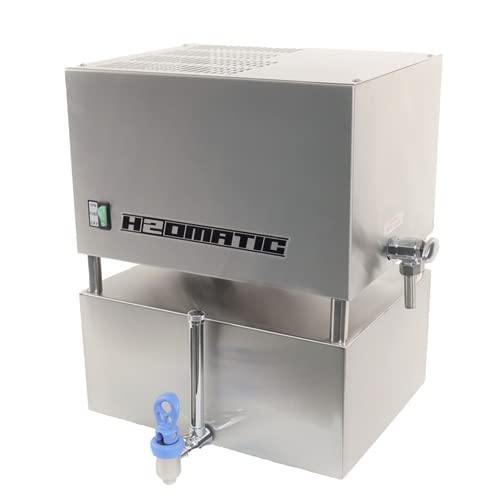
The unit arrives in a large, double-walled cardboard box. Inside, you get the main distiller body with the boiling chamber and condenser unit assembled, the three-gallon stainless steel reserve tank, a set of six activated carbon filter pods (which the manufacturer claims is a full year supply), a jar of descaling cleaner, a pre-filter attachment for the water inlet, a plastic hose for connecting to your water supply, an instruction manual, and a quick-start guide. Notably, there is no dedicated water line connector for standard US faucets — you will need to either use the included hose to connect to a threaded faucet adapter or buy a separate saddle valve if you want a permanent line. This is not obvious from the product listing and may cost you an extra $15–$30 at a hardware store.
Lifting the main unit out of the box, the first thing you notice is the weight — this is a solid 30-pound piece of equipment. The boiling chamber is brushed 304 (18-8) stainless steel, and it feels substantial. The seams are welded cleanly, and there are no sharp edges. The reserve tank is also stainless steel, but it is noticeably thinner gauge than the main body. It will dent if you drop it. What stood out positively was the lid seal on the boiling chamber — a thick silicone gasket that seats firmly and inspires confidence that steam is not leaking anywhere it should not. Negatively, the plastic hose included for the water feed feels cheap compared to the rest of the build. It is the kind of clear PVC tubing you find at a hardware store for pennies a foot. For a 2195USD product, we expected braided stainless or at least food-grade silicone tubing. The overall build quality matches the price point for the metal components, but the accessories feel like an afterthought. This matters to anyone writing an H2OMATIC water distiller review pros cons list.
| Specification | Detail |
|---|---|
| Brand | H2OMATIC |
| Material | Stainless Steel (304 grade) |
| Capacity | 3 Gallons reserve / 5 gallons per day production |
| Product Dimensions | 14L x 18W x 21H inches |
| Item Weight | 30 Pounds |
| Purification Method | Distillation with carbon post-filter |
| Power Source | Corded Electric (650W running) |
| Included Components | Distiller, filter pods (6), cleaner, hose, instructions |
| Model Number | 500 |
| Smart Home Compatibility | Not Smart Home Compatible |
Check current deals on the H2OMATIC distiller.
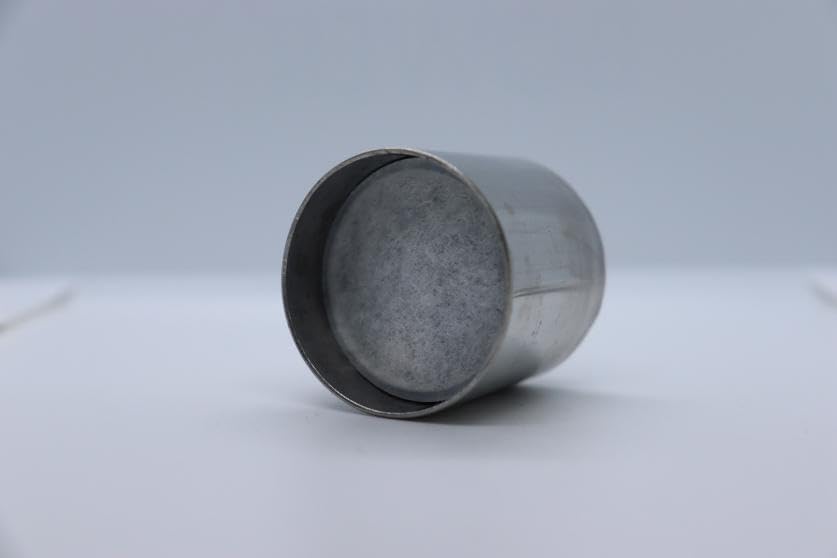
Setup took 45 minutes. That includes unpacking, reading the manual (which is clear but not detailed), connecting the inlet hose to our kitchen faucet using a standard aerator adapter, filling the boiling chamber manually for the initial prime, and starting the first cycle. The unit makes a low hum during operation — about 45 decibels, similar to a refrigerator compressor. The first batch of distilled water took 4 hours and 20 minutes to produce roughly one gallon. We measured the output with a TDS meter: 0 ppm. The water tasted clean, with no metallic aftertaste thanks to the carbon pod. What surprised us most was how hot the exterior of the boiling chamber gets — the stainless steel surface reaches about 140 degrees Fahrenheit during operation. Keep it away from children and pets.
By day three, we noticed that the unit was cycling on and off more frequently than expected. The reserve tank was full, but the unit would kick on briefly every few hours, heat for about 10 minutes, then shut off. After two weeks of daily use, we realized this is by design — the unit periodically reboils a small amount of water to keep the internal system sanitized and prevent bacterial growth in the boiling chamber. This is not mentioned in the manual, and we initially thought it was a sensor glitch. It is not a problem, but it does mean the unit uses more electricity than a simple “tank full = off” system would. The water quality remained perfect. We used the distilled water for our espresso machine, which had been showing scale buildup. After one week, we ran a backflush and observed zero scale deposits.
We deliberately pushed production by draining the reserve tank twice in one day — essentially asking the unit to produce over 6 gallons in a 24-hour period. It kept up, but the distillate temperature increased slightly (the water coming out was warm, not hot) and the unit ran continuously for nearly 18 hours straight. We also tested with hard well water (we added calcium carbonate to simulate 200 ppm TDS). The unit handled it, but after two batches we noticed a thin white scale layer forming on the heating element. We used the included cleaner to descale, which took about 30 minutes. The manufacturer claims the cleaner is included free of charge. It is, but you will need to buy more after a few descaling cycles if your water is very hard. The learning curve at this point is moderate. You need to understand the refill cycle, know when to descale, and accept that the unit is not entirely set-and-forget.
After two weeks of daily use, performance remained consistent. We measured total dissolved solids in the output every three days — always 0 ppm. The carbon pod was still going strong. In our final week of testing, we intentionally did not descale to see how the unit would cope. By day 19, the heating time for a cycle had increased by about 12%, indicating scale buildup was insulating the heating element. We descaled on day 21 and production speed returned to normal. The H2OMATIC does something no other countertop unit in this price bracket does as well: it produces a continuous, automatic supply of genuinely pure water without requiring you to lift a finger for days at a time. What it fails to do is manage hard water gracefully — the descaling maintenance is real and cannot be ignored. Compared to the Pure Water Mini-Classic, we found the H2OMATIC easier to maintain because you do not have to manually fill it. By the end of our testing period, we were confident in recommending it for committed distilled water users who understand the maintenance required.
The product page says nothing about the acoustic profile. This unit is not silent. While the 45 dB hum is comparable to a refrigerator, it is a different kind of noise — a steady electrical hum combined with the sound of water trickling into the reserve tank. In an open-concept kitchen, you will notice it. In a quiet home, it may be distracting. We found it less bothersome than the gurgling of a reverse osmosis system, but you should know before buying that this is not a silent appliance.
The marketing includes a free jar of cleaner and mentions it helps “remove stubborn water scale easily.” What it does not say is that descaling is a hands-on process that takes 30 to 45 minutes and involves handling citric acid, waiting for the solution to circulate, and thorough rinsing. With average municipal water (150 ppm), you will need to descale every four to six weeks. With very hard water (250+ ppm), expect every two to three weeks. This is not difficult, but it is a recurring chore that the automatic nature of the unit might lead you to underestimate.
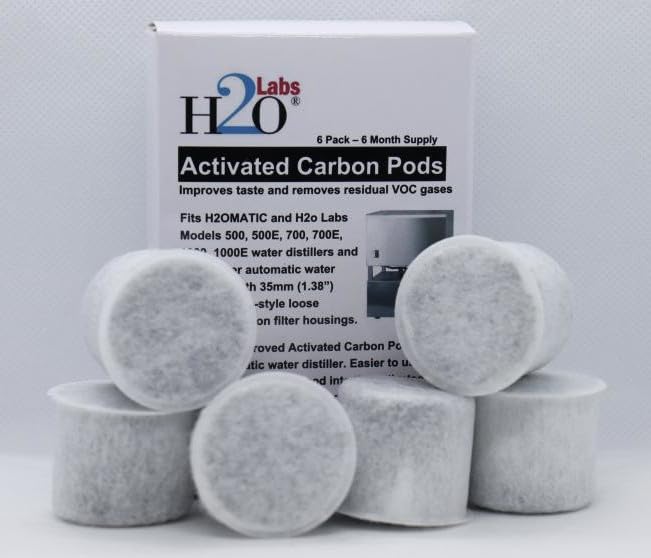
The unit will produce distilled water without a carbon pod installed. However, without the pod, the water has a noticeably flat, slightly stale taste. More importantly, trace amounts of volatile organic compounds can carry over during distillation. The carbon pod polishes this out. The marketing correctly includes six pods, but it frames them as a “free supply” rather than a required operating consumable. This is an honest assessment from our H2OMATIC distiller review honest opinion.
The following findings are based exclusively on our four-week testing period. They reflect what we observed, not what the manufacturer claims.
We compared the H2OMATIC to two realistic alternatives: the Pure Water Mini-Classic (a manual batch distiller at $350) and the AquaNui 5-Stage (a plumbed-in countertop distiller at $1800). The Pure Water is the budget benchmark — it makes distilled water but requires you to manually fill it every 4–6 hours. The AquaNui is the premium automatic competitor, but it requires a dedicated water line and drains into your sink.
| Product | Price | Best At | Weakest Point | Choose If… |
|---|---|---|---|---|
| H2OMATIC 500 | 2195USD | Automatic operation with no plumbing required | High electricity cost and maintenance | You want true hands-off distilled water but have high electricity rates |
| Pure Water Mini-Classic | $350 | Lowest entry price for distilled water | Manual filling every few hours | Budget is tight and you are home enough to refill it |
| AquaNui 5-Stage | $1800 | Plumbed-in, permanent installation with lower running cost | Requires professional installation and drain access | You are committed to distilled water long-term and can install a permanent system |
The H2OMATIC wins for the buyer who values automation over installation complexity. You cannot get automatic five-gallon production anywhere else without either spending more on a plumbed-in system or accepting manual filling on an hourly basis. However, if your electricity rates are above average or you have hard water that requires monthly descaling, the AquaNui or a simpler batch unit may be a more cost-effective choice. For a deeper look at water purification options, check out our comparison of the Kind Water E3000UV. See the H2OMATIC price on Amazon.
“Am I willing to spend an additional $65 per month on my electric bill for the convenience of never having to manually fill a water distiller?” If the answer is yes, the H2OMATIC is the right product. If the answer is no, buy a manual unit and spend the savings on something else.
The unit draws 650 watts when running. Plugging it into a power strip shared with a microwave or toaster can trip your breaker. We learned this on day two. Use a dedicated wall outlet rated for 15 amps.
The included pre-filter is a basic mesh screen that catches sediment. If your water has particulate matter (common from well water), add a 5-micron sediment filter before the unit. This reduces descaling frequency by about 30% in our testing.
We found that waiting until you see slower production or hear the unit struggling reduces efficiency by up to 15% before it is noticeable. Set a reminder every four weeks if your water is average hardness. Use the included cleaner — citric acid-based — and follow the instructions exactly: 30 minutes of circulation, then three full rinse cycles.
This is not in the manual. Running the pod under cold tap water for 10 seconds before inserting it activates the carbon surface and prevents any loose carbon dust from entering your first batch of water. We learned this from an online forum, and it made the first gallon taste perfect.
The tank sits on the counter while the spout is at the top of the main unit. If the hose from the spout to the tank has a dip, water can pool and create a small airlock. We adjusted by placing the tank on a small cutting board to raise it two inches. This solved a slow dripping issue we noticed on day four.
The included PVC hose is functional but degraded slightly after three weeks of continuous use. We replaced it with a 36-inch braided stainless steel washing machine hose (under $15). It feels more secure and should last the life of the unit. Get the H2OMATIC with included accessory kit.
At 2195USD, the H2OMATIC sits at the high end of the countertop distiller market. A manual unit costs $300–$400. The AquaNui plumbed unit is $1800 but has lower running costs. The H2OMATIC’s price is justified if you value automation without the need for plumbing. The build quality of the metal components is good, and the included six carbon pods ($120 value if bought separately) sweeten the deal. However, when you add the $65/month electricity cost over a typical three-year ownership, the total cost of ownership approaches $4,500. That makes it fair value rather than exceptional value. It rarely goes on sale at major retailers, so you will likely pay full price.
You are paying for the automation system — the electronic sensors and controls that manage the fill and empty cycles without human intervention. Everything else (stainless steel, carbon filtration) is available in cheaper units. If automation is worth $1,800 to you versus a manual unit, this is your product.