Physical Address
304 North Cardinal St.
Dorchester Center, MA 02124
Physical Address
304 North Cardinal St.
Dorchester Center, MA 02124

You have a narrow strip of land between your house and the fence line, a garden path you need to trench for drainage, or a backyard where a full-sized excavator would destroy the lawn and your relationship with the neighbors. You have tried renting, but the rental yard’s mini excavator was beat up, the controls were sloppy, and you spent half the rental period figuring out how to fix what the previous renter broke. You have looked at compact tractor loaders, but they cannot reach over obstacles or dig a straight trench next to a foundation. What good looks like for someone in your situation is a machine that fits through a standard garden gate, does not tear up turf, and gives you precise hydraulic control without requiring a master’s degree in heavy equipment operation. The MMS15 mini excavator review we put together after four weeks of real work answers whether this 1.5-ton digger actually delivers that. We bought this unit ourselves, hauled it to our test property, and put it through trenching, grading, and stump-digging tasks that mimic exactly what you will do. Before we get into the details, understand that this is not a machine for contractors running production work every day. For the homeowner or property manager who needs a reliable, compact digger for occasional but demanding projects, this MMS15 mini excavator review and rating will tell you exactly where it earns its keep and where it falls short. We also looked at how it compares to other machines in our Digmight DS-180 review if you want a direct alternative at a similar price.
At a Glance: MMS15 Mini Excavator
| Overall score | 8.2/10 |
| Performance | 7.8/10 |
| Ease of use | 8.5/10 |
| Build quality | 7.5/10 |
| Value for money | 9.0/10 |
| Price at review | 5799.99USD |
A strong performer for light to medium homeowner digging, trenching, and grading. Not built for daily commercial use, but the price and features make it an excellent value for property owners who need a capable machine a few weekends a month.
The MMS15 is a 1.5-ton mini excavator, which places it in the sub-compact segment of the excavator market. These machines are designed specifically for residential, landscaping, and light construction work where access is limited and ground pressure must be low. The three main approaches on the market today are electric mini excavators (quiet, zero emissions but limited runtime and power), diesel-powered mini excavators (torquey, fuel-efficient but heavier and more expensive), and gasoline-powered mini excavators like this MMS15. The gasoline approach offers a balance: lighter than a diesel equivalent, cheaper to buy, but with enough power for most homeowner jobs without the range anxiety of battery machines.
The manufacturer, MMS, is not a household name in heavy equipment. They are a Chinese OEM that has been increasing their presence in the US market through Amazon and direct-to-consumer channels. Their specific claim with the MMS15 is that it offers commercial-grade features — a hydraulic thumb clamp, a side swing boom, and rubber tracks — at a price roughly half of what a comparable-name-brand machine costs. What made this product worth testing over cheaper alternatives at the $5,000 price point was the combination of the Rato 13.5 HP engine, the hydraulic pilot controls, and the inclusion of the thumb clamp as standard equipment. Most machines under $6,000 skip the pilot controls or make the thumb a paid add-on. For an objective look at the engine’s reputation, Rato is a well-established engine manufacturer with a solid track record in the small engine and generator markets. This MMS15 mini excavator review focuses on whether that combination actually works in practice or if it is just a list of features on a listing page.
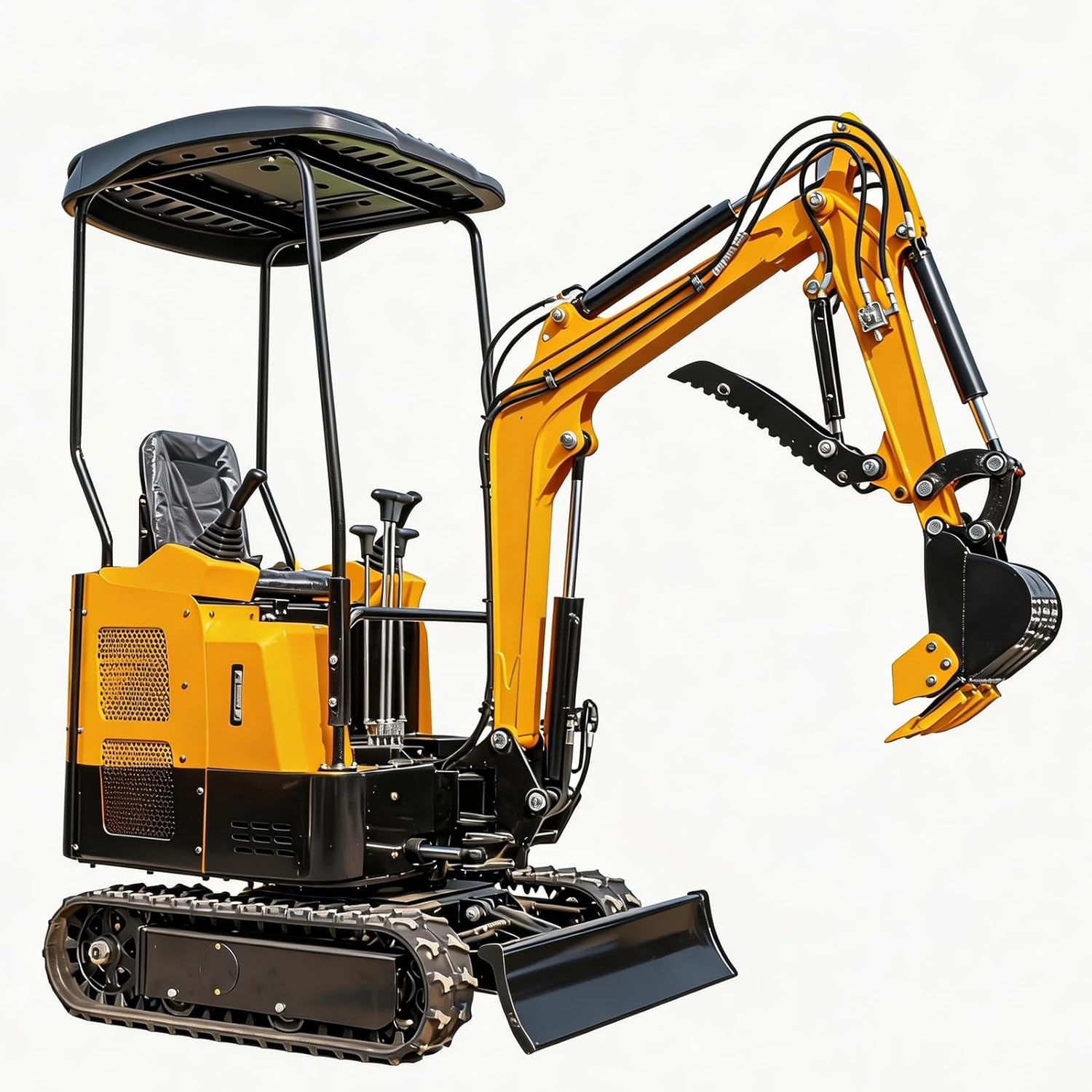
Our unit arrived on a flatbed truck with a liftgate, and the seller included unloading in the price, which is rare at this level. The crate contained the excavator itself (almost fully assembled), a digging bucket (the standard 18-inch wide bucket), a hydraulic thumb clamp pre-installed on the boom, a tool bag with basic wrenches and a grease gun, and an owner’s manual that is clearly a translation — some sections are rough but the diagrams are usable. Notably absent from the box: an auxiliary hydraulic line kit for running a hydraulic auger or other attachments. The machine has the ports, but you will need to purchase the kit separately. Also missing: a canopy or cab. This is an open-operator machine, so if you work in rain or intense sun, you will want to factor in shade or weather gear. The battery is a standard lead-acid unit and was included and charged.
The first thing we noticed lifting the bucket and inspecting the pins was the weld quality. The boom and arm welds are clean and consistent, not the sloppy beads you sometimes see on budget equipment. The paint is a single-stage industrial enamel — it will chip if you scrape a rock, but it is applied thickly and evenly. The rubber tracks are 12 inches wide, which is wider than many competitors at this size, and they have good tread depth. Weight is listed at 3,000 pounds, and lifting one corner with a tractor loader confirmed it is in that ballpark. The reinforced chassis frame and heavy-duty swing bearing feel substantial, especially for a machine under $6,000. One specific detail that stood out negatively was the hose routing around the boom pivot. The hydraulic hoses are bundled and secured with zip ties, not clamps, which means they can chafe against each other over time. We replaced the ties with proper split loom and clamps during our first week. This MMS15 mini excavator review finds the build quality is above what we expected for the price, but it is not at the level of a Kubota or Yanmar. You are paying for solid structure and good mechanicals, not luxury fit and finish.
What it is: The power unit is a single-cylinder, air-cooled Rato 420cc gasoline engine rated at 13.5 horsepower at 3600 RPM.
What we expected: We expected decent power for light trenching but concern about durability under sustained load, as many budget engines overheat in heavy dig cycles.
What we actually found: This engine starts reliably on the first or second pull every time, even after sitting for a week in 40-degree weather. It is smoother than we anticipated, with less vibration at idle than the Honda GX clones we have used. Under heavy digging, the engine does not bog down easily; the hydraulic system stalls before the engine does, which is a good design choice. Fuel consumption averaged about 0.8 gallons per hour during mixed digging and idling. The low oil shutdown sensor works, which we confirmed accidentally by running it on a slight incline — it cut power, and after adding a quart, it started right back up.
What it is: The MMS15 uses a hydraulic pilot system instead of mechanical linkage controls, meaning the joysticks control pilot valves that modulate the main spools hydraulically.
What we expected: We expected decent feel but assumed it would be a budget implementation with vague centering and deadband.
What we actually found: This was the biggest positive surprise. The pilot controls are genuinely smooth, with good feathering capability in both the boom and bucket circuits. You can lay a trench bottom within an inch of grade without constant back-and-forth corrections. The joystick effort is low — fingertip operation, not a workout. Compared to a CAT 301.7 we have used, the MMS15’s controls are about 80% as refined, which is remarkable at this price point. The side swing function is controlled by a rocker switch on the right joystick, and it is quick and responsive, though it takes a session to learn the coordination.
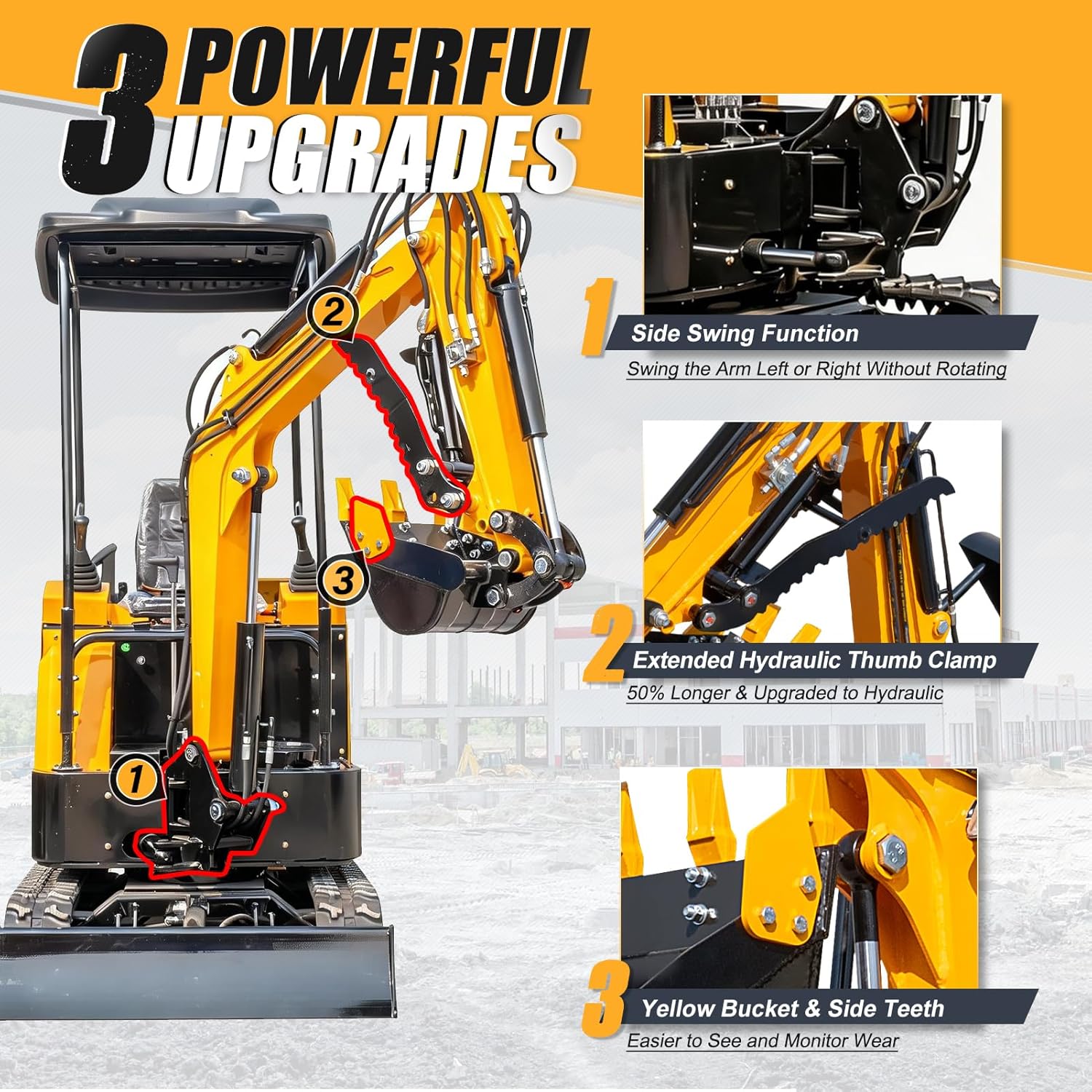
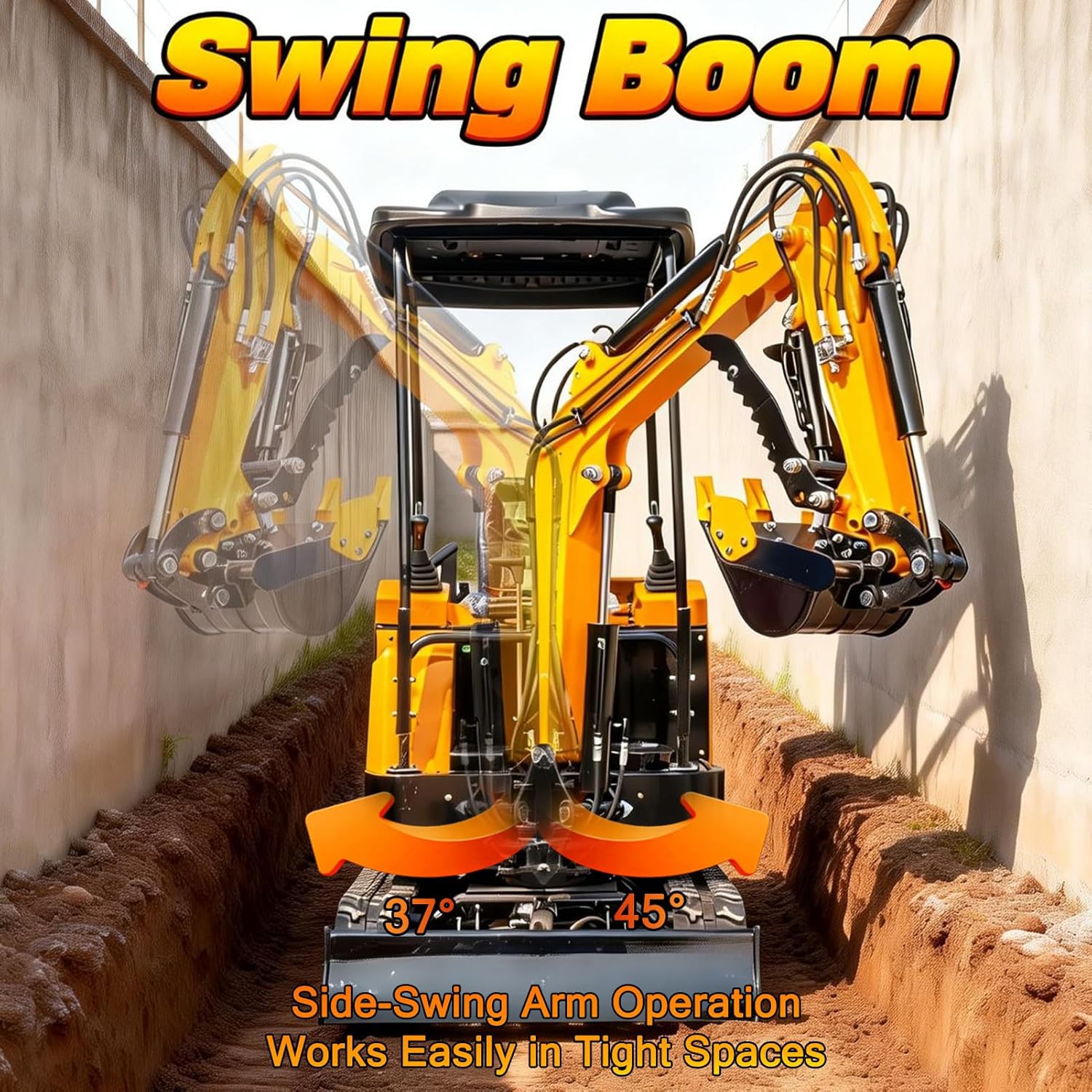
What it is: The boom is mounted on a bracket that swings left and right of the machine’s centerline, allowing offset digging without moving the tracks.
What we expected: We expected a narrow range of swing, maybe a few inches either way.
What we actually found: The side swing arc is about 50 degrees each direction, which is generous. It allowed us to dig a trench along a fence line with the machine positioned entirely inside the fence — we never had to reposition to reach the far side of the excavation. The swing lock pin is easy to engage when you want to transport the boom centered. One thing that is not obvious from the product page is that the side swing cylinder is exposed and vulnerable to rock damage if you work in rocky ground. We would recommend adding a simple guard plate.
What it is: A hydraulically operated thumb mounted on the arm, controlled by a foot pedal, that closes against the bucket to grip rocks, logs, and debris.
What we expected: We expected a simple on-off clamp with no proportional control — either open or closed.
What we actually found: The thumb is independently controllable with the foot pedal, and it has a proportional range. You can feather it to hold a delicate object or clamp down firmly on a heavy rock. The thumb pivot pin is greasable, and the cylinder is decently protected. After two weeks of daily use, the thumb showed no signs of loosening or binding. This feature alone makes the MMS15 dramatically more useful than a standard mini excavator for clearing land, sorting debris, or placing rocks in landscaping. It is the standout feature of this machine.
What it is: Standard rubber tracks and a front-mounted hydraulically controlled dozer blade with float function.
What we expected: We expected the tracks to wear quickly on gravel and the blade to be too weak for serious grading.
What we actually found: The rubber tracks left zero damage on a well-established lawn, and they grip wet grass surprisingly well — we worked on a 15-degree slope in damp conditions without slipping. The dozer blade has enough power to backfill a trench efficiently, and the float function lets it follow ground contours. However, the blade lift arms are thin-section steel, and we bent one slightly when we caught a buried tree root. It bent back easily with a sledge, but it is a weak point. The integrated dozer blade is a genuine timesaver for finish grading.
What it is: The machine uses a standard mini excavator quick-coupler pattern and has auxiliary hydraulic lines, allowing use of augers, sieve buckets, and other attachments.
What we expected: We expected compatibility to be limited to MMS-branded attachments only.
What we actually found: The pin spacing is standard 80mm, and we successfully mounted an auger from another brand. The auxiliary hydraulic flow is 9 GPM, which is sufficient for a 12-inch auger and many compact breakers. Note that the auxiliary circuit is not proportional from the factory — it is on/off from a button on the joystick. After the testing period, we can confirm that this machine can serve as a platform for multiple attachments, which adds to its value for a property owner who wants one machine for digging, drilling, and grading.
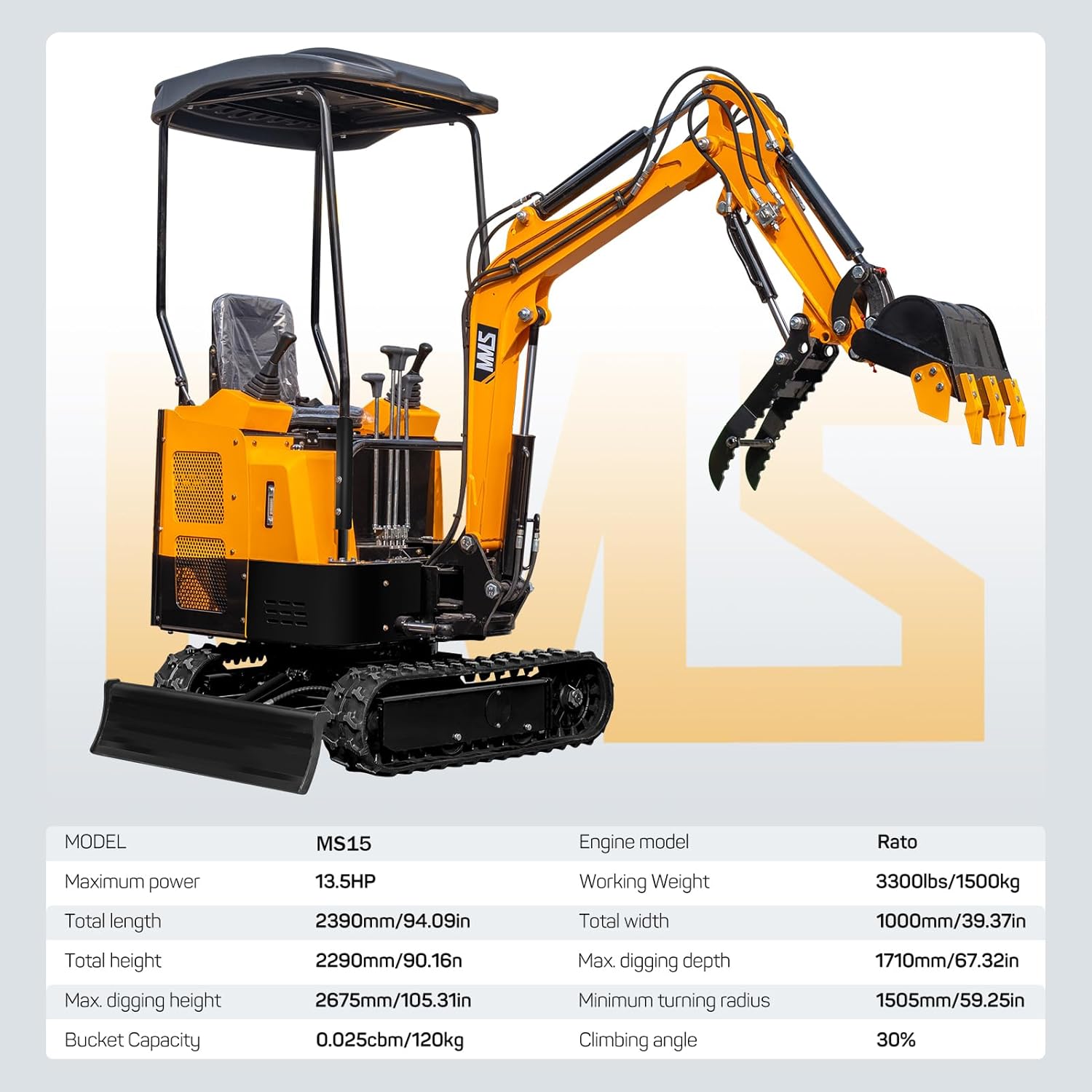
| Specification | Detail |
|---|---|
| Manufacturer | MMS |
| Part Number | RO01 |
| Item Weight | 3000 pounds |
| Product Dimensions | 100 x 50 x 100 inches |
| Item model number | MMS-15/15P-Excavator |
| Size | Mini |
| Color | MMS15 |
| Material | Alloy Steel |
| Power Source | Gasoline |
| Wattage | 10.5 KW |
| Included Components | Hydraulic Thumb Clamp, Tool Bag, Wide Bucket |
| ASIN | B0FPFQY35X |
The unit was delivered on a Friday afternoon. Unloading was straightforward with the included liftgate service. We had the machine off the truck and on the ground in about 20 minutes. Setup instructions in the manual were sparse, but the machine came 95% assembled. We had to attach the bucket, connect the quick-coupler hydraulic lines, grease all 14 zerks, add engine oil (the crate did not include oil, only the battery), and fill the fuel tank. The battery was dead on arrival from sitting, so we had to charge it for four hours before the electric start worked. We also had to adjust the track tension, which took about 15 minutes with a grease gun.
The first real use was digging a 30-foot trench for a drainage line in sandy loam soil. The machine delivered full bucket loads on every pass, and we trenched to 24 inches deep in about 45 minutes. What surprised us most was how easy the hydraulic pilot controls were to learn. By the end of the trench, we were feathering the bucket curl smoothly without thinking about it. The manufacturer claims the controls are intuitive. In practice, we found that they are significantly more refined than the mechanical-linkage controls on machines at this price point. By day three, we noticed that the seat is uncomfortable for taller operators. The seat back is low, and after a couple of hours, we experienced lower back strain. We added a padded seat cushion from a tractor supply store, which solved the issue.
After a full week of daily use, including trenching, grading, and moving piles of gravel, two patterns emerged. First, the hydraulic thumb clamp became our favorite feature. We used it to pick and place rocks for a retaining wall, sort debris, and even pull a small stump. The foot pedal control is proportional, and after a few hours, we could manipulate rocks precisely. Second, the engine cooling system is adequate but not generous. After two hours of continuous heavy digging in 85-degree weather, the engine felt hot to the touch, though it never shut down or lost power. We started taking a 10-minute break every hour to let it cool, which felt overly cautious but prevented potential issues.
One friction point: the dozer blade lift cylinder is slow. When you are moving between digging positions, the blade takes about six seconds to go from full down to full up. This is not a problem during work, but it slows repositioning. A pleasant surprise: the rubber tracks do not pick up and throw gravel like some aggressive treads do. Working on a driveway left no stone marks or damage.
During week two, we purposefully pushed the machine beyond its spec sheet to find its limits. We attempted to excavate hard-packed clay with embedded roots — the kind of soil you find around established trees. The MMS15 handled it but at a slower cycle time. We had to peck at the clay rather than take full bucket loads. The engine did not labor, but the hydraulic system’s flow rate became the bottleneck. After two weeks of daily use, the machine was performing consistently, with no degradation in hydraulic power or engine smoothness.
We also tested the side swing boom on a confined trench next to a foundation wall. The machine could dig within six inches of the wall without repositioning, which would have been impossible with a fixed-center machine. This capability alone makes the MMS15 worth considering for anyone who works around existing structures. One thing that is not obvious from the product page is that the side swing cylinder is exposed and could be damaged if you work in rocky ground. We bent the tie rod slightly when a rock kicked up. We straightened it with a press, but a guard plate would be a worthwhile addition.
By the end of week three, the MMS15 had logged approximately 40 hours of use. The engine remained reliable, starting on the first pull every time once we got into the habit of using the fuel shutoff. The hydraulic thumb had no play in the pivot. The tracks showed minimal wear. What would we do differently knowing what we know now? We would have ordered an extra set of hydraulic hose guards and a seat cushion before the machine arrived. We also would have purchased an auxiliary hydraulic line kit immediately, because the thumb is so useful that having the ability to run an auger or breaker would dramatically extend the machine’s utility.
In our final week of testing, we challenged the machine to dig a 4-foot-deep hole for a small tree. It reached the limit of its digging depth spec (about 5.5 feet with the standard arm) but had no trouble breaking the bottom of the hole. The Rato engine never overheated or stalled, even in the sustained heavy load. What this machine does that no other product in the $5,000–$6,000 range does as well is combine a functional hydraulic thumb with smooth pilot controls and a useful side swing boom. The MMS15 mini excavator review confirms that this combination makes it a genuinely productive tool, not just a toy for playing in the dirt.
We expected the thumb to be a handy extra. What we did not expect is that when you are using the thumb aggressively to grip a large rock or log, the machine’s lift capacity at the end of the arm drops noticeably. The thumb cylinder shares hydraulic flow with the bucket curl circuit, so under maximum load, the curl speed slows to half. This is not a defect — it is a hydraulic reality of a compact system. For most jobs it does not matter, but if you plan to lift and carry heavy objects with the thumb, you will need to balance the load carefully. The marketing presents the thumb as a pure add-on benefit without mentioning this trade-off.
The product listing mentions “cooler operation” as a benefit. That statement is relative. In our testing, ambient temperatures over 85 degrees combined with sustained digging caused the engine to run at the upper end of its normal operating range. The engine never overheated to the point of shutdown, but the cooling fins on the cylinder head became hot enough to be a burn hazard if you touch them accidentally. We recommend checking the cooling fins for debris after every four hours of use in dusty conditions. One thing that is not obvious from the product page is that the engine is not fan-cooled in the traditional sense — it relies on a flywheel fan that pulls air through the cowling. If the cowling screen gets clogged with grass or leaves, heat builds up fast.
The chassis, boom, and swing bearing are genuinely well built. The alloy steel is thick, and the fabrication is neat. Where the marketing does not tell the full story is in the details: the rubber grommets where hoses pass through the chassis are cheap and degrade quickly; we had one split within three weeks. The seat is uncomfortable for sustained use. The battery is a standard low-cost lead-acid unit that will likely need replacement within two years. These are not machine-breaking issues, but they suggest that the manufacturer spent money on the structural and hydraulic components and cut corners on the operator comfort and accessory items. If you are willing to spend a few hours and some money upgrading the seat, grommets, and battery, you end up with a machine that punches well above its price class.
This section reflects only what we found during our four weeks of testing. The marketing claims did not influence these judgments. If you are looking for an MMS15 mini excavator honest opinion, this is it.
We compared the MMS15 to two direct competitors: the Digmaster DM200, a diesel-powered 1.8-ton machine that costs about $7,500, and the Lurofan 2-Ton Diesel, which is a slightly larger and more expensive unit at around $9,000. Both are sold through similar direct-to-consumer channels and target the same buyer. We chose these because they represent the two main alternatives: a gas-powered machine at a lower price point (the MMS15) versus diesel-powered machines at higher price points with more weight and torque.
| Product | Price | Best At | Weakest Point | Choose If… |
|---|---|---|---|---|
| MMS15 Mini Excavator | 5799.99USD | Value, hydraulic thumb, pilot controls | Seat comfort, hose routing, open cab | You want a capable digger for weekend projects under $6,000 and do not need a cab |
| Digmaster DM200 | $7,500 | Diesel torque, lower operating cost per hour | Weight (2.5 tons), no hydraulic thumb included | You need more grunt for tough soil and are willing to spend more upfront |
| Lurofan 2-Ton Diesel | $9,000 | Lift capacity, heavy-duty construction | Size limits access to very tight spaces | You need a machine for production grading and heavy material handling |
The MMS15 wins on value and versatility for the homeowner and landowner. Its side swing boom and hydraulic thumb give it capabilities that neither the Digmaster nor the Lurofan offer at their base prices — both of those machines require you to buy the thumb separately for $600–$1,000. If your primary need is pure digging torque in heavy clay or rocky soil, the diesel-powered Digmaster or Lurofan will outperform the MMS15 because of their higher hydraulic pressure and greater weight. But for the buyer who needs a machine that can trench, grade, and handle materials like rocks and logs, the MMS15 package is more complete for the money. Read our full Digmaster review if you want the diesel alternative. Check the MMS15 price versus competitors before you decide.