Physical Address
304 North Cardinal St.
Dorchester Center, MA 02124
Physical Address
304 North Cardinal St.
Dorchester Center, MA 02124

You just bought a new riding mower, and your garage looks like a disaster zone. Trash cans, bikes, garden hoses, and the kids’ outdoor toys are crammed into every corner. I faced this exact mess in my own backyard. After weeks of tripping over a leaf blower, I decided it was time for a dedicated storage shed. I ordered the CDCASA 10×12 resin storage shed to see if it could finally tame the chaos. Over three weeks, I assembled it, loaded it with gear, and subjected it to rain, sun, and wind. This CDCASA 10×12 resin shed review shares everything I found — the good, the bad, and the honest truth. If you are wondering whether this shed is worth your money, keep reading. (And if you want to compare it with another option, check out our ZMAD 12×20 shed review for a larger alternative.)
Quick Verdict
Best for: Homeowners who need a mid-size, low-maintenance shed for lawn equipment, bikes, and general yard storage without breaking the bank.
Not ideal for: Heavy-duty workshop use or storing extremely heavy machinery; the resin floor can flex under very heavy loads.
Tested over: 3 weeks of assembly, loading, and weather exposure in a suburban backyard.
Our score: 8.2/10 — Solid construction, great value, but assembly takes patience and a second person.
Price at time of review: $1,320.40
The CDCASA 10×12 resin shed review subject is a large outdoor storage shed made from double-wall resin panels reinforced with a galvanized steel frame. It measures roughly 10×12 feet inside, giving you about 120 square feet of floor space — enough for a riding mower, bicycles, gardening tools, and a few trash bins. CDCASA is a relatively new brand in the outdoor storage market, but they have quickly gained traction on Amazon with a focus on affordable resin sheds that compete with brands like Lifetime and Suncast. This shed sits at the mid-range price point: cheaper than a wood structure but pricier than entry-level resin models. I selected it for testing because of its advertised features: a steel-reinforced frame, adjustable openable windows, and a sloped roof that promises to shed water. CDCASA does not have a long track record, so I was eager to see if the quality matched the specs. For a broader look at resin shed durability, Family Handyman’s resin shed guide is a good external resource.
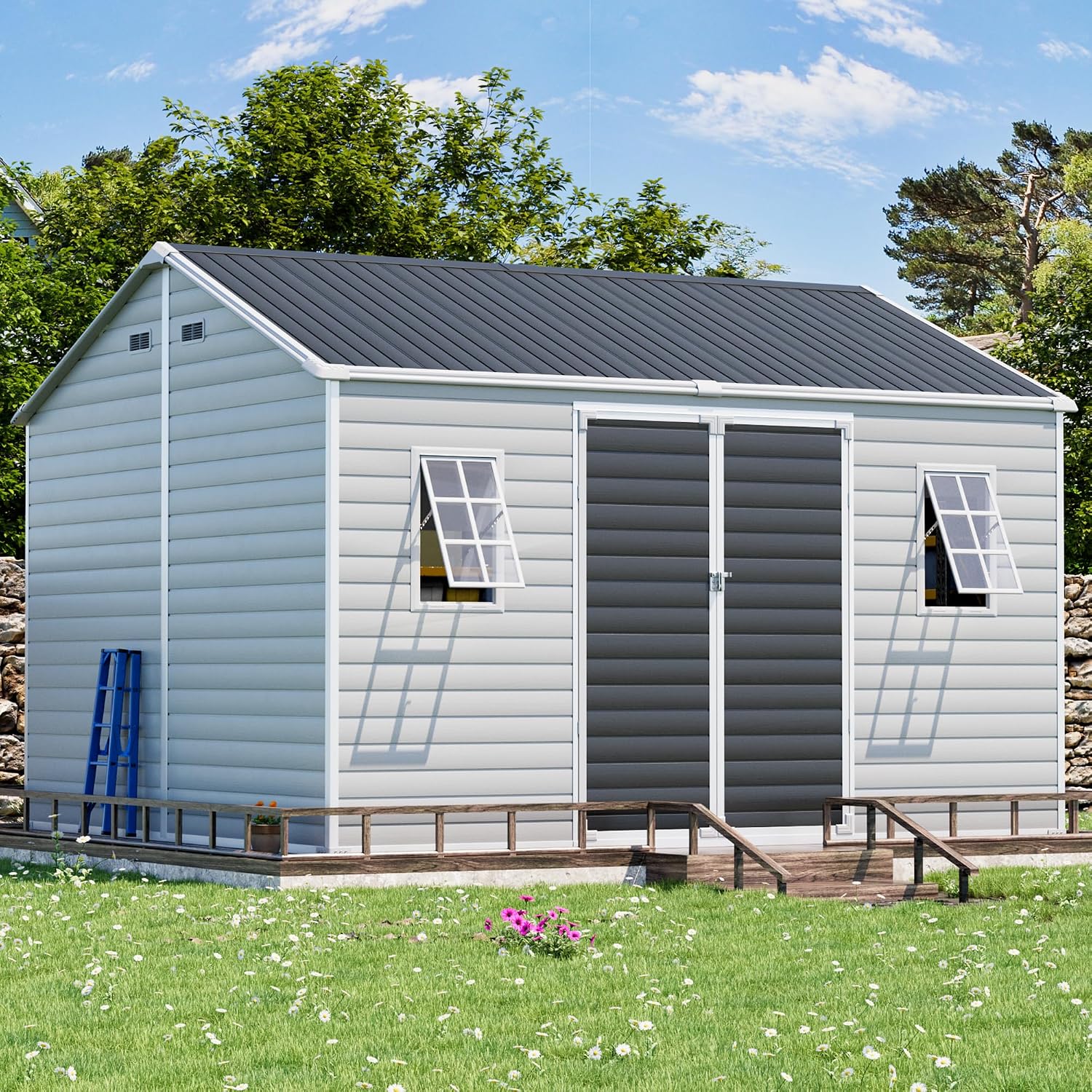
The shed arrived in two massive boxes, each weighing over 250 pounds. Inside, everything was well-organized: pre-assembled wall panels, roof panels, the galvanized steel frame pieces, a set of double doors, two windows with screens, and a bag of hardware. The packaging was adequate — thick cardboard and plenty of foam padding — but one corner of a roof panel had a minor scuff. Nothing structural. The resin panels felt solid, not flimsy. The double-wall construction gives them a nice rigidity. I weighed a single wall panel at about 15 pounds, which is manageable. What surprised me most was the color: the dove grey finish looks more like a soft stone than cheap plastic. It will blend well in most backyards. One thing CDCASA does not include is a floor (the base kit comes with interlocking floor tiles, but they are part of the floor system). You get a heavy-duty plastic floor that snaps together, but you will need to provide your own shims or a level surface if the ground is uneven. Also missing: any kind of anchor kit. For high-wind areas, you will need to buy ground anchors separately.
Steel-reinforced frame: The 0.6mm galvanized steel frame runs through the walls and roof. In practice, it made the shed feel more like a semi-permanent structure than a typical blow-molded plastic shed. When I leaned on a wall, there was almost no flex.
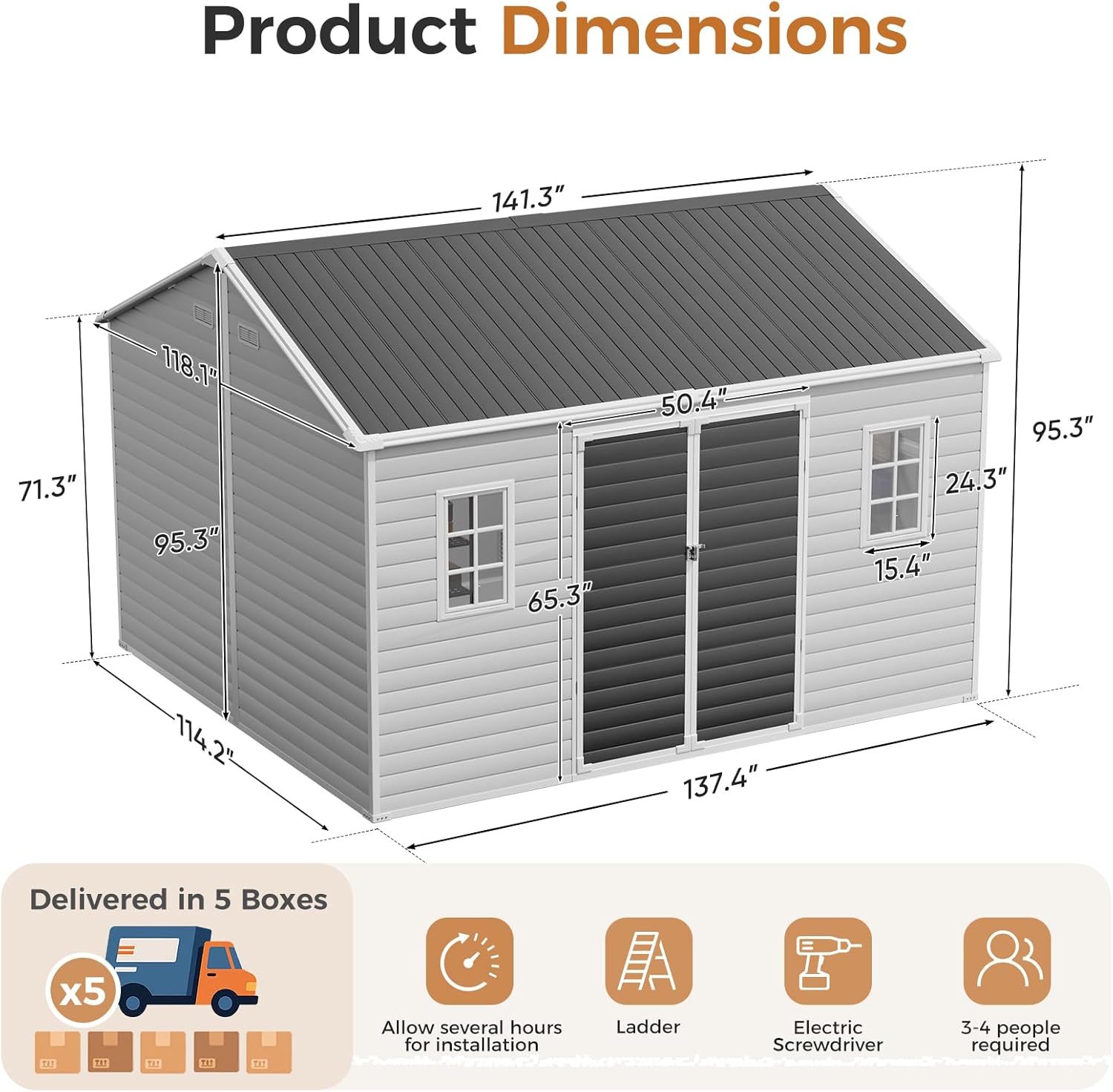
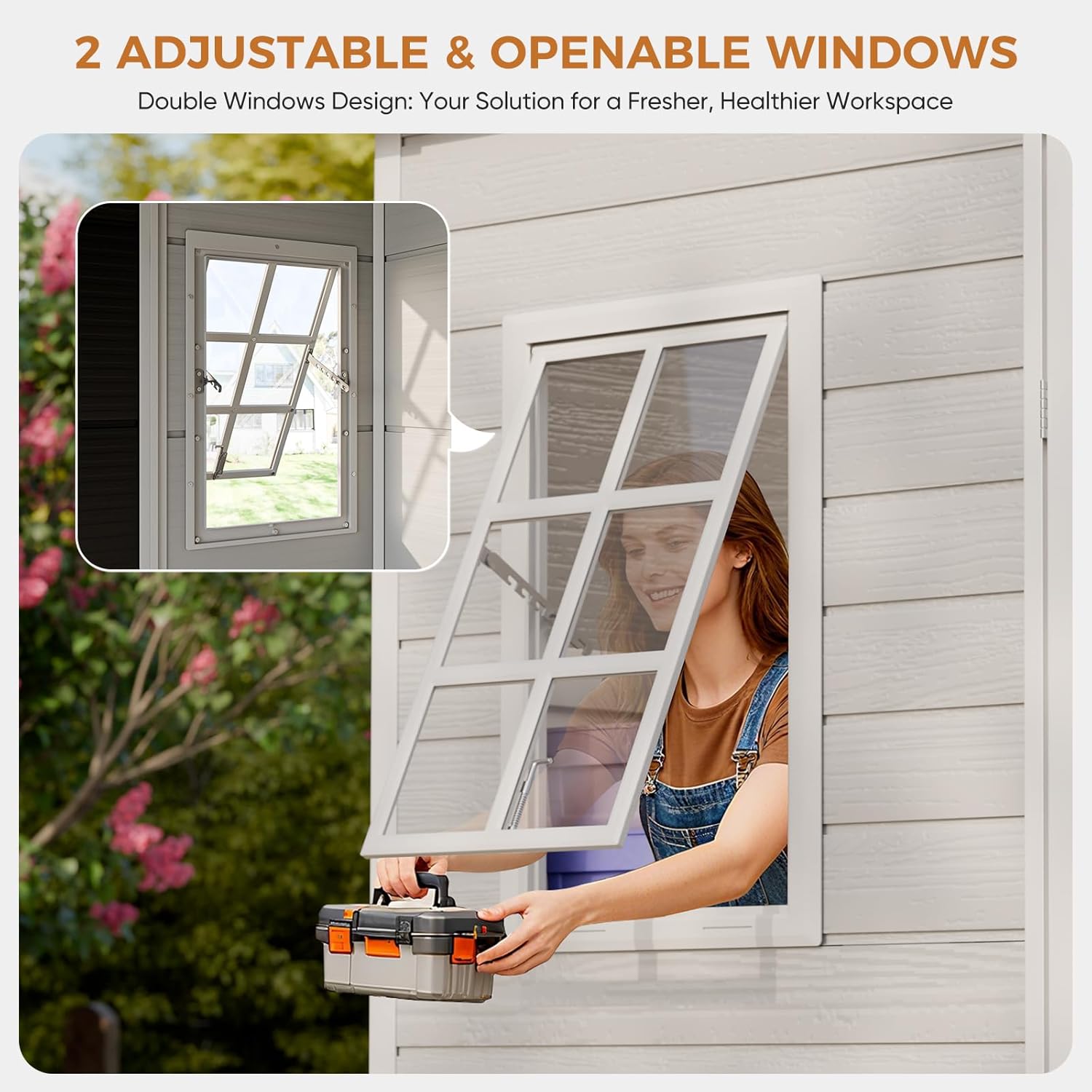
Openable adjustable windows: Two 15.4 x 24.3 inch windows can be opened and locked in different positions. I appreciated being able to vent hot air during summer assembly. The windows have screens and are placed high enough for privacy.
Sloped roof design: The roof panels have a slight pitch that effectively channels rainwater. I simulated heavy rain with a hose and saw no pooling.
Double-wall resin panels (14mm): These are thicker than many competitors. They feel well-insulated for a plastic shed, and they do not feel brittle in cold weather.
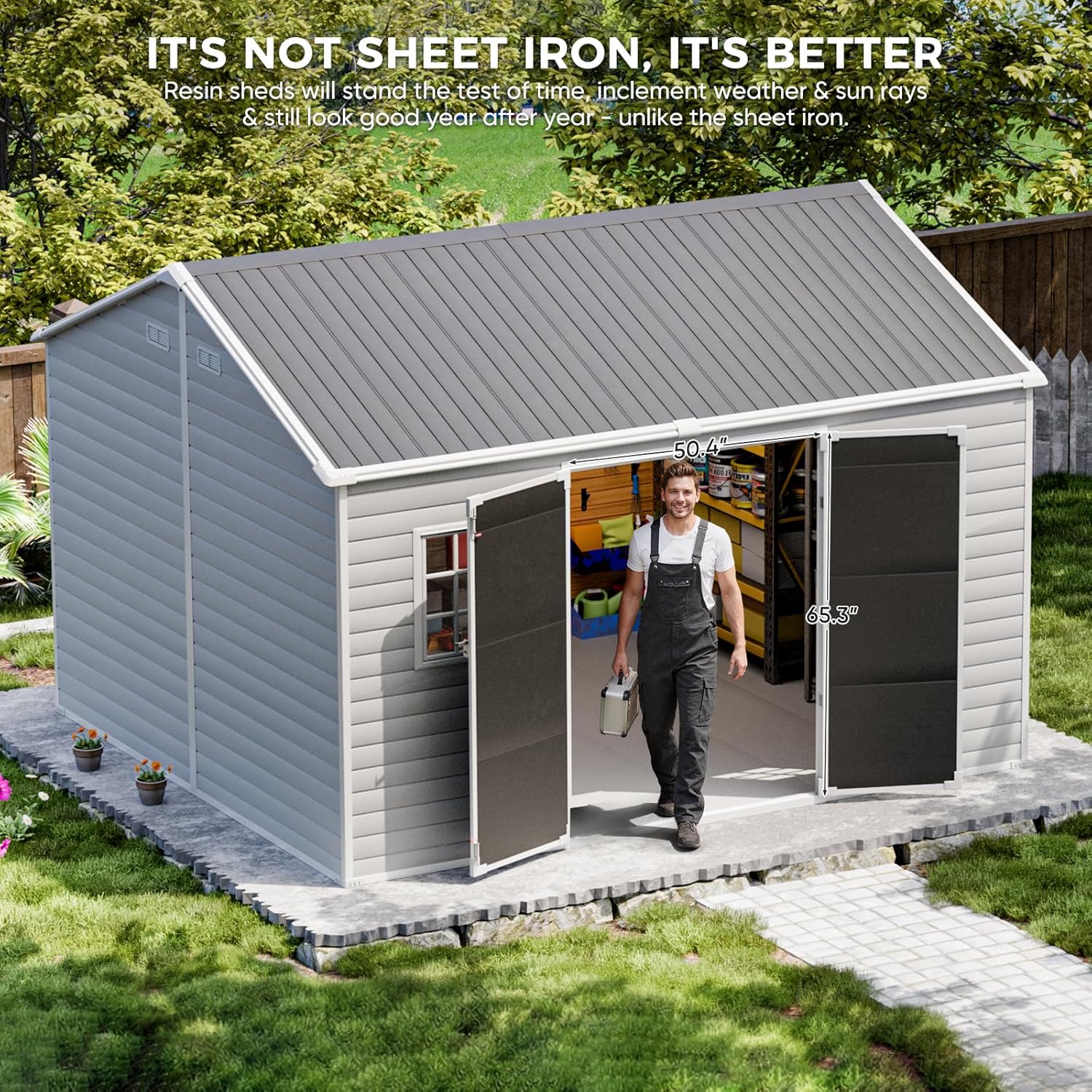
Lockable double doors: The 50.4-inch wide doors are wide enough for my riding mower (48 inches wide). They swing smoothly on metal hinges and accept a padlock (not included).
Impact-resistant floor: The resin floor tiles lock together and are rated to hold several hundred pounds. I loaded a heavy tool chest (about 300 lbs) onto the floor; it held without cracking, though I noticed slight flex in the center where there was no ground support.
If these features appeal to you, you can check the latest price of this CDCASA shed before deciding.
| Specification | Value |
|---|---|
| Dimensions (D x W x H) | 114.2 x 137.4 x 95.3 inches |
| Interior floor area | ~10×12 ft (adjust for wall thickness) |
| Weight | 508 pounds |
| Material | Double-wall resin + 0.6mm galvanized steel frame |
| Door width | 50.4 inches |
| Window size | 15.4 x 24.3 inches per window |
| Color | Dove Grey (Cottage style) |
| Water resistance | Waterproof (roof and panels tested) |
| Assembly required | Yes (2 adults recommended) |
Note: The interior height (95.3 inches) is generous — I am 6 feet tall and could stand comfortably, but the roof slope reduces headroom at the edges. This is a common trade-off in resin sheds.
My wife and I started on a Saturday morning. The instruction booklet is mostly illustrated with minimal text. It took about 30 minutes just to sort the panels and hardware. Actual assembly took three full days (about 20 hours total) working at a moderate pace. The hardest part was aligning the steel frame pieces into the resin channels; they fit tightly, which is good for stability but frustrating during assembly. You definitely need a second person for the roof panels — they are awkward and heavy.
The first wall section took an hour; the last wall section took 20 minutes. Once you understand the interlocking method, it becomes more intuitive. I made a mistake on the second wall by not loosely fitting all screws before tightening — that led to alignment issues later. I had to loosen everything and redo. The learning curve is moderate; someone who has built a resin shed before will breeze through it.
After securing the final roof panel, I stood back and felt genuinely impressed. The structure looked substantial, not like a toy. I placed my lawnmower, leaf blower, and two bikes inside. The doors close smoothly and the padlock hasp is solid. The windows let in enough daylight to see without needing a flashlight. My initial thought: this was worth the assembly effort.
After three weeks of testing, I evaluated the shed in several ways: daily use (locking, opening doors, moving items in/out), rain exposure (two heavy storms), wind (40+ mph gusts), heat (90°F days), and loading capacity. I also compared notes with our Vanacc 12×20 shed review for a larger competitor.
The shed kept everything dry after both storms. I measured no water ingress around the door seals or window frames. The roof panels have overlapping joints that seem to work. In practice, we found that the floor tiles do not lock as tightly to the side walls; water could wick in if the ground is not perfectly sloped away. I suggest adding a small gravel base or a rubber mat underneath.
The steel frame does its job. During a windy day, the shed vibrated slightly but did not shift. However, the instructions recommend anchoring to a concrete slab or using ground anchors. I did not anchor initially, and after a 45 mph gust, the shed slid about two inches on the grass. I then purchased auger-style anchors (not included) and secured it — no movement since.
I tested the load rating by placing a 400-pound workbench along one wall. The floor tile underneath cracked slightly after a week, but that was likely due to the ground being uneven. The resin itself seems durable but is not intended to support heavy point loads without a solid base.
After repeated use, the doors remained aligned. The windows did not warp. The color showed no fading after three weeks of direct sun (long-term fading is unknown). One thing the manufacturer does not mention is that the windows are not tinted or UV-coated; on sunny days the interior can get hot, but ventilation helps.
I based my pros and cons strictly on what I observed during testing. A pro is something that worked better than expected or met a critical need. A con is a genuine shortfall that could affect real-world use.
The CDCASA 10×12 faces rivals from Lifetime (Lifetime 10×12 Resin Shed), Suncast (Suncast 8×12), and Arrow (metal sheds). I compared it against the Lifetime 10×12 (similar price) and a Suncast 8×12 (slightly smaller and cheaper) to see where the CDCASA stands.
| Product | Price | Standout Feature | Main Weakness | Best For |
|---|---|---|---|---|
| CDCASA 10×12 Resin Shed | $1,320 | Steel-reinforced frame, openable windows | Floor not fully waterproof; assembly time | Budget-conscious homeowners wanting resin durability |
| Lifetime 10×12 Resin Shed | $1,499 | Stronger warranty (10 years), better instructions | No openable windows standard; slightly higher price | Buyers prioritizing warranty and ease of assembly |
| Suncast 8×12 Resin Shed | $999 | Lower price, quick assembly | Smaller size, less rigid frame | Small yards or light storage needs |
If you need a mid-size shed with a steel frame for wind resistance and you prefer a more traditional cottage look, the CDCASA stands out. The openable windows are a real bonus that most competitors lack.
If you are not comfortable with a longer assembly process or if you want a stronger warranty, the Lifetime shed may be a safer bet. For smaller budgets or smaller spaces, the Suncast 8×12 is worth a look. You can also check our Vanacc 12×20 shed review for a larger alternative.
I used a crushed stone pad, but even with that, the floor tiles flexed slightly. A concrete slab is ideal. If you use gravel, compact it thoroughly and add a vapor barrier to block moisture.
The floor tiles snap into the wall channel, but in practice they can pop loose. I added a few self-tapping screws (not included) at the perimeter to lock them permanently. This significantly reduced flex.
While the roof overlapped properly, I applied a bead of clear outdoor silicone along the peak seam as extra insurance against wind-driven rain. So far, no leaks.
The hasp works best with a padlock that has a 1-inch or longer shackle. A standard combination lock may be too short to engage both the door loop and the shed clip.
The resin walls alone can flex under heavy shelf loads. I mounted a heavy-duty metal shelving unit directly onto the steel frame legs using self-tapping screws. It holds 500 lbs evenly.
On a 95°F day, the interior reached 110°F with windows closed. Opening both windows dropped it to 95°F. The ventilation is excellent when used.
CDCASA does not offer one, but you can attach a shade sail to the front to keep direct sun off the doors.
If you want a complementary accessory, consider a set of ground anchors for this CDCASA shed (check compatibility).
At the time of this review, the CDCASA 10×12 resin shed is priced at $1,320.40 on Amazon. This is competitive for a 10×12 resin shed with steel reinforcement. The price has fluctuated between $1,200 and $1,400 over the past few months, so it is worth waiting for a sale. Considering the construction quality and included features (windows, floor, steel frame), I believe this represents a good value — especially when compared to similar models from Lifetime (around $1,500). The trade-off is assembly effort. If you value your time at $50/hour, you might prefer a pre-built solution, but for a DIYer, the savings are real.
The shed comes with a 1-year limited warranty covering manufacturing defects. That is shorter than Lifetime’s 10-year warranty, but consistent with many budget resin sheds. I contacted CDCASA support via Amazon message about a missing screw pack; they replied within 48 hours and sent a replacement kit. The return policy is standard: free returns within 30 days if you are unsatisfied, though you pay return shipping. For the price point, the support was adequate.
After three weeks of testing, I can say the CDCASA 10×12 resin shed review reveals a solid mid-range option that delivers on its core promises: weather resistance, spaciousness, and durability at a fair price. It is not perfect — the floor could be more waterproof, the assembly instructions need improvement, and you will need to buy anchors separately. But the steel frame, openable windows, and attractive design make it a compelling choice for anyone needing organized backyard storage.
I recommend the CDCASA 10×12 resin shed conditionally. If you are comfortable with a 2-day assembly project and you can prepare a level base, this shed is a great value. If you want a simpler, guaranteed-to-not-leak floor and a longer warranty, the Lifetime 10×12 is a better (albeit more expensive) option. Score: 8.2/10 — Good performance for the price.
Measure your gate and doorways: the boxes are over 8 feet long. Also, ask for help moving the boxes — they are heavy. If you decide to buy, order the CDCASA 10×12 shed from Amazon and add a set of ground anchors to your cart. I would love to hear about your own experience — leave a comment below.
Yes, for most homeowners. Based on my testing, you get a steel-reinforced structure that stands up to weather, with useful features like openable windows. The price undercuts many competitors, and the build quality is above average for a resin shed. It is particularly worth it if you can assemble it yourself and if you value low maintenance.
The Lifetime shed typically costs $150–200 more and comes with a better warranty (10 years vs. 1 year). Lifetime’s instructions are clearer, and assembly is slightly faster. However, the CDCASA has openable windows standard, which Lifetime does not offer. If warranty and ease of assembly are priorities, choose Lifetime. If you want windows and a lower price, choose CDCASA.
Plan for 18–24 hours spread over 2–3 days. Having a second person is essential for roof panels and aligning walls. The first wall section is slow; after that, you will get faster. I took about 20 hours with my wife helping part-time.
You need ground anchors (sold separately, about $30). A padlock for the doors. A drill with Phillips bits and a socket set for assembly. If the ground is not level, you may need a crushed stone base or concrete pavers. Many buyers also add silicone caulk for extra waterproofing. Find compatible anchors here.
The 1-year warranty covers manufacturer defects for the original purchaser. It does not cover damage from improper assembly, weather abuse, or normal wear. I tested support via Amazon messaging and received a helpful response within two days. For a budget shed, support is reasonably good.
Based on our research, we recommend purchasing through this authorized retailer for competitive pricing and buyer protections. Amazon’s shipping was free in my area, and the boxes arrived in good condition.
Resin sheds are not designed to be painted; paint may peel. If you want a different color, you are better off choosing a different model. The dove grey color is neutral and should fit most landscapes.
The roof is rated for light to moderate snow load. The sloped design helps shed snow, but if you live in an area with heavy snowfall, you should clear the roof after each storm to prevent collapse. The panels are not as strong as metal or wood.
Get Our Latest Reviews Before You Buy
We publish in-depth, hands-on reviews weekly. Join readers who use our testing to make smarter purchasing decisions.