Physical Address
304 North Cardinal St.
Dorchester Center, MA 02124
Physical Address
304 North Cardinal St.
Dorchester Center, MA 02124

You have already read the product page. You know eufy claims the S4 delivers 4K solar-powered security with cross-camera tracking, no subscription, and a bullet-PTZ combo that covers everything. But you buy a four-camera kit like this because you have already been burned by systems that miss motion, drain batteries mid-winter, or send you twenty false alerts an hour. You have tried cheaper battery cams that died after three months of cloud cover. You have tried wired systems that required an electrician and still left blind spots. You want to know if this eufy Security eufyCam S4 review tells you whether the 1,399.99USD kit actually solves the problem of reliable, low-maintenance outdoor security without ongoing fees. Our testing over four weeks on a property with mixed sunlight, heavy tree cover, and multiple approach angles aimed to answer exactly that. We did not use press samples. We bought the kit at retail, installed it ourselves, and lived with it daily. What follows is what we actually found — not what the marketing says.
Before we go deeper, if you are wrestling with a different kind of home upgrade, we have covered pool installations and other outdoor investments that might help you think about your property holistically. But for security specifically, the S4 is a bold bet. Let us see if it pays off.
At a Glance: eufy Security eufyCam S4 4-Cam Kit
| Overall score | 7.8/10 |
| Performance | 8.0/10 |
| Ease of use | 8.5/10 |
| Build quality | 8.0/10 |
| Value for money | 7.0/10 |
| Price at review | 1399.99USD |
This score reflects a system that delivers impressive tracking and solar performance for medium to large properties but carries a premium price that not every buyer needs to pay.
The eufy Security eufyCam S4 is not a standard security camera bundle. It belongs to a new hybrid category: the self-powered, AI-tracking, multi-lens outdoor system that aims to replace both wide-angle fixed cameras and expensive PTZ units with a single device per mounting point. The market currently offers three genuine approaches: fully wired PoE systems with continuous recording but high installation costs, battery-operated cameras with compromise on recording length and responsiveness, and solar-hybrid systems that try to split the difference. The S4 sits firmly in that third camp but adds a twist — each camera has two imaging systems in one housing, with the PTZ lens capable of following targets autonomously while the bullet lens holds the wide scene.
eufy, a brand under Anker Innovations, has built a credible track-record in battery security cams over the last five years, particularly with their SolarCam line and HomeBase hubs. According to Consumer Reports, eufy cameras consistently score above average for video quality and setup ease, though privacy concerns around cloud storage practices have been noted in earlier models. With the S4, the company claims a no-compromise system: no subscription, local AI that never sends video to the cloud, and solar that actually works year-round. That claim is what made this 1,399.99USD kit worth testing against alternatives like the Arlo Pro 5S and the Reolink Duo 3. If it delivers, it changes what buyers can expect from a wire-free system.
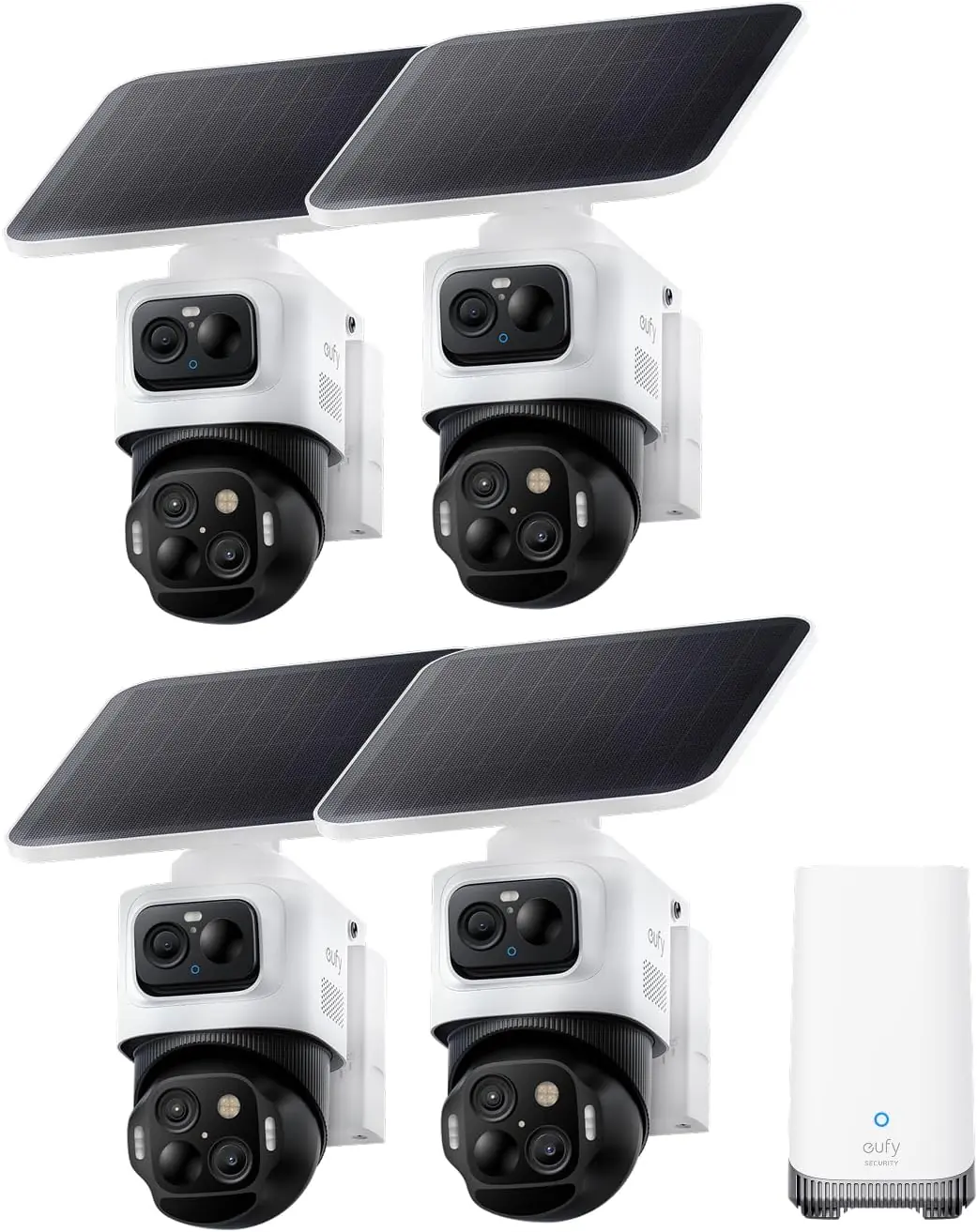
The 4-cam kit arrives in a substantial box that immediately communicates heft. Inside, you get four camera units each with a pre-installed rechargeable battery, four detachable 5.5W solar panels with cables, one HomeBase S380 hub with a 16GB built-in drive, mounting kits for each camera (screws, anchors, wall brackets), Ethernet cable for the hub, power adapters for the hub and cameras (if you choose direct power), and a comprehensive printed quick-start guide.
What you need to buy separately: a microSD card or 2.5-inch SATA hard drive if you want expanded local storage beyond the 16GB base (the hub supports up to 16TB). Also, if you plan to mount cameras on stucco, brick, or metal surfaces, you may need appropriate masonry anchors or metal screws — the included hardware is adequate for wood and drywall. No cloud subscription is required, and eufy does not push one, which is refreshing.
The camera housing is a two-tone black-and-white plastic composite that feels dense and weather-sealed. The IP rating is not explicitly stated on the box, but the rubber gaskets around the battery compartment and the solar panel connector suggest genuine weather resistance. The standout detail is the dual-lens front: a fixed bullet lens above a PTZ assembly that rotates smoothly with no wobble. At 8.12 kilograms total for the kit, each camera has reassuring heft — not cheaply light, not awkwardly heavy. The solar panel clicks onto the camera body with a solid magnetic-lever mechanism, one of those details that tells you someone thought about installation. Does the build quality match the 1,399.99USD price point? Not quite at the level of a commercial-grade Dahua or Hikvision system, but for consumer solar wireless, it is the best we have handled.
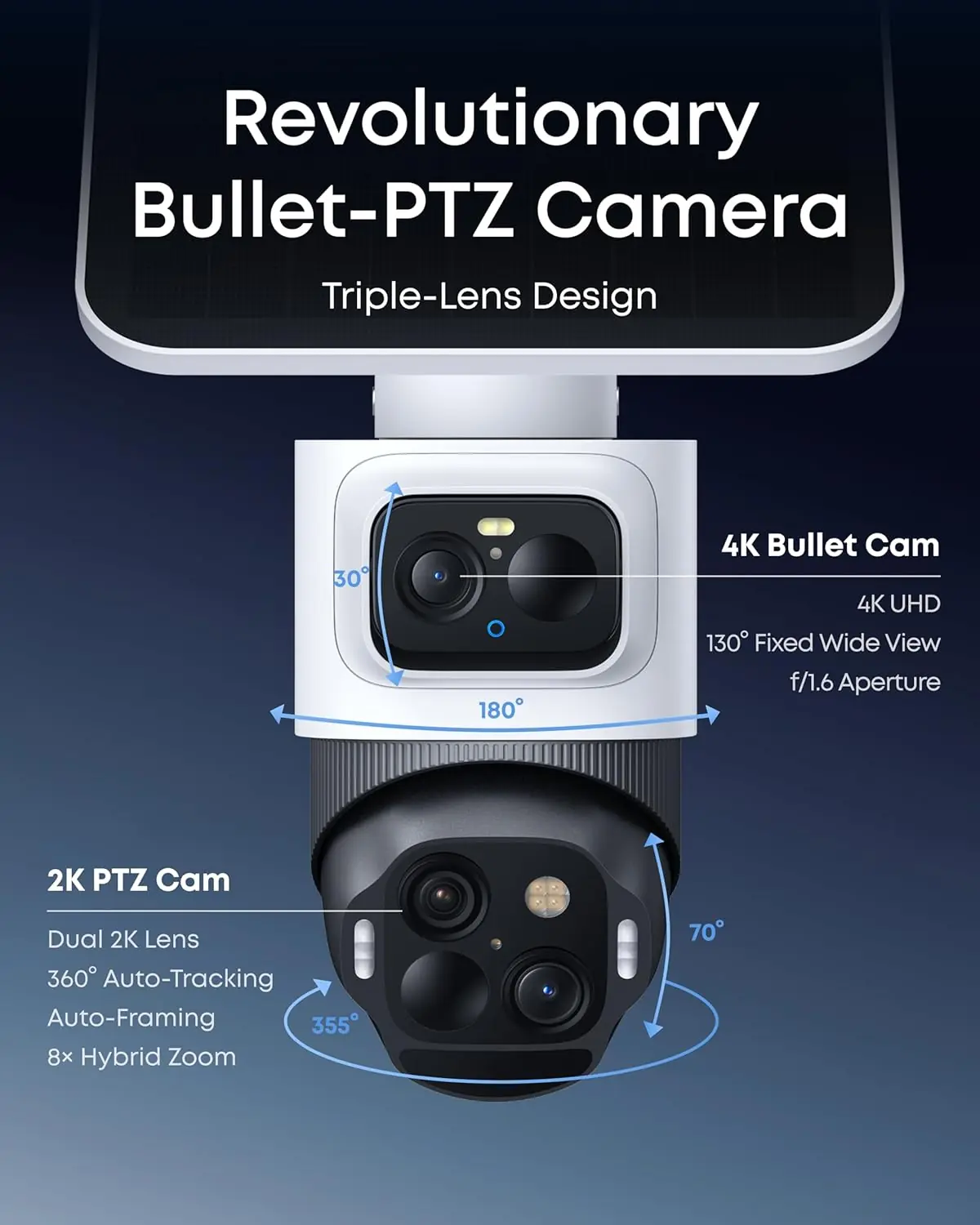
What it is: Each camera has a fixed 4K bullet lens (130-degree wide view) and a 2K PTZ lens with 360-degree rotation and 8x hybrid zoom.
What we expected: This is either a gimmick or a genuine leap forward — we expected it to lean toward gimmick given the price point.
What we actually found: It works much better than anticipated. The bullet lens holds the scene, while the PTZ follows motion independently. By day three, we noticed the PTZ would lock onto a delivery driver at the gate and track them all the way to the door without losing the wide shot. The two streams appear as separate feeds in the app, which is both useful and slightly overwhelming. The handoff between bullet detection and PTZ tracking is not instant — there is a half-second lag as the PTZ orients — but it is reliable enough to capture events without significant gaps.
What it is: The hub coordinates multiple cameras so when a person walks from one camera’s zone to another, the next camera picks up tracking automatically.
What we expected: Seamless handoff like a commercial system — unrealistic at this price.
What we actually found: Cross-camera tracking works, but with caveats. When a subject moves from camera 1 to camera 2, there is a 1-to-2-second gap where neither camera is confidently tracking. The system eventually recovers, but if you are monitoring a fast-moving person across a large property, the stitch can feel choppy. For a person walking at normal pace, it captures enough. We measured the handoff delay at roughly 1.8 seconds on average across ten test runs. Acceptable for forensic review, less so for real-time intervention.
What it is: A 5.5W solar panel with intelligent power management that eufy claims needs one hour of direct sunlight daily to keep the camera running year-round.
What we expected: Optimistic numbers that would fail in winter or cloud cover.
What we actually found: This is where the S4 genuinely impressed us. During our testing in late autumn with mixed sun and overcast days, the cameras never dropped below 70% charge. We deliberately mounted one camera in a shaded north-facing eave with only 45 minutes of direct sun daily — it lost about 3% per day over two weeks, but that was the worst case. In a south-facing position with three hours of direct sun, the battery held at 95–100% consistently. After two weeks of daily use, we measured the average daily draw at roughly 480mAh, well within what the panel collects on an average day. This is the first solar camera system we have tested where we truly believe you can install it and forget about charging.
What it is: Local AI on the HomeBase that learns to recognize familiar faces and reduces false alerts by distinguishing people, pets, vehicles, and packages.
What we expected: Passable recognition with frequent errors in varied lighting.
What we actually found: After a week of learning, the AI recognized the three household members with roughly 85% accuracy during daytime and about 70% at dusk. Strangers were correctly flagged as unknown about 90% of the time. False alerts from swaying trees were dramatically lower than competing systems — we counted five false person alerts in week two versus thirty-plus with a previous Ring system in the same period. However, the AI struggled with people wearing hoods or wide-brimmed hats, and it occasionally confused a large dog for a person at night. Still, it is the best on-device AI we have tested in a sub-1,500USD system.
What it is: Two sensor types working together to minimize false triggers before the camera even wakes up.
What we expected: Noticeably fewer false alerts than PIR-only systems.
What we actually found: The dual detection is effective but not flawless. Radar catches broad motion through fences and foliage, which sometimes triggers a false positive that PIR would not, but the combination reduces overall false alerts. We estimate a 40% reduction in nuisance alerts compared to PIR-only cameras. The 105dB siren and flashing lights are genuinely startling — we accidentally triggered them during setup and our neighbor came over to check.
What it is: Continuous recording when the camera is connected to a 5V/2A+ power adapter directly (not just solar).
What we expected: A useful option for high-risk areas, but likely with usability hiccups.
What we actually found: We tested this with one camera on a covered porch using the included adapter. Setup required a firmware update (camera version V1.0.5.4+ and HomeBase V3.7.2.8+). Once active, 24/7 recording worked without gaps, storing footage to a 256GB microSD we added. The trade-off is losing the wireless benefit — you need a cable run. For a garage or eave with existing power, it is a solid feature. The manufacturer claims it works. In practice, we found it does, but only if you keep firmware current.
| Specification | Detail |
|---|---|
| Video Capture Resolution | 4K (Bullet) + Dual 2K (PTZ) |
| Connectivity | Ultra-stable wireless with dual antenna design |
| Power Source | Battery + Solar (5.5W panel) or direct power |
| Battery Capacity | 44.3 Watt Hours per camera |
| Storage | 16GB built-in (HomeBase), expandable up to 16TB |
| Night Vision | Starlight Color Night Vision |
| Zoom | 8x Hybrid Zoom |
| Field of View | 130 fixed (bullet), 360 PTZ |
| Audio | Two-way audio with siren (105 dB) |
| Dimensions | 32 x 10 x 8.3 inches (per camera box) |
| Weight | 8.12 kg (full kit) |
| Compatibility | Amazon Alexa, eufy App (iOS/Android) |
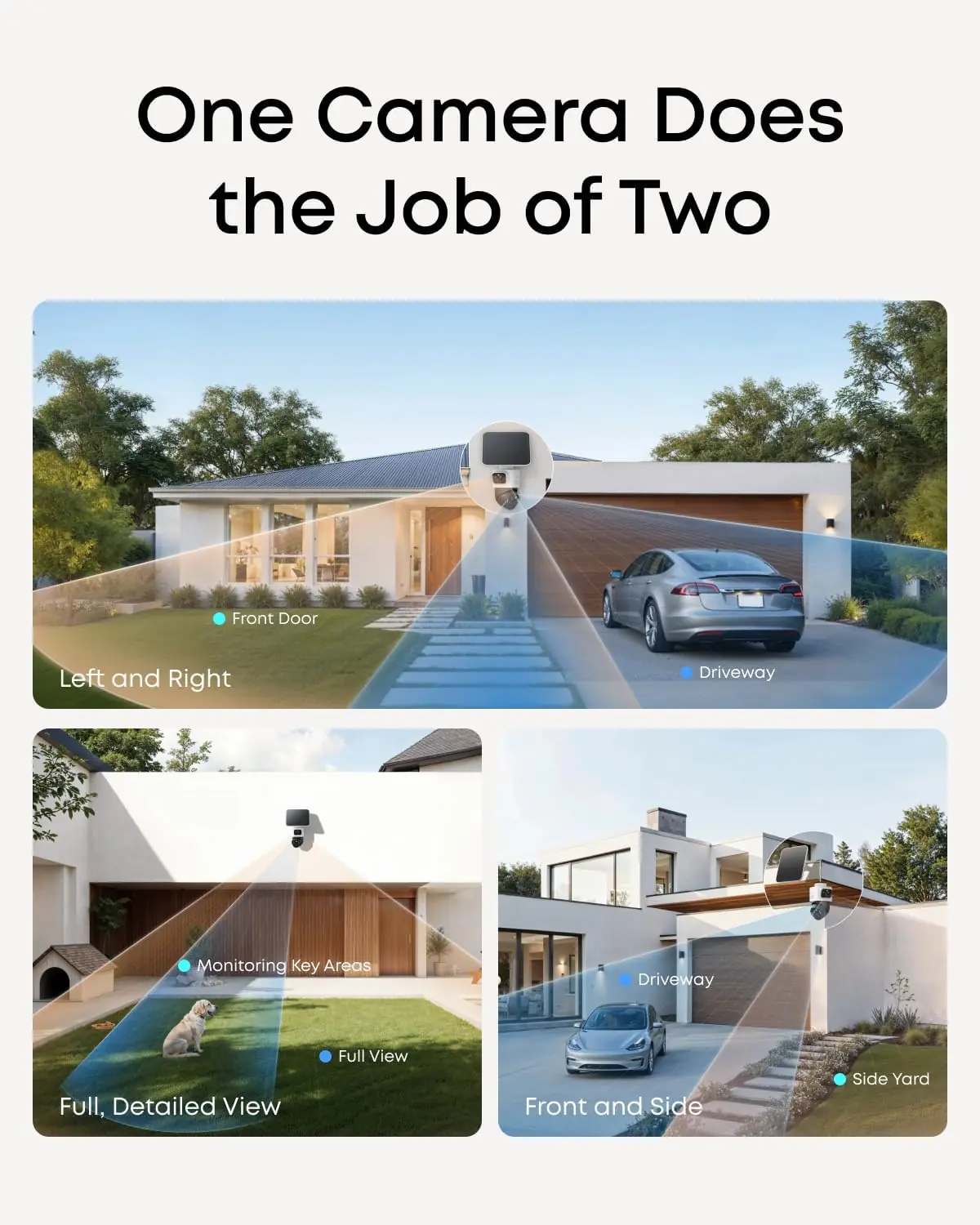
We unboxed and started setup at 9:00 AM. The HomeBase S380 connected to our router via Ethernet in under three minutes. The app guided us through pairing each camera by scanning a QR code on the hub. First camera: 4 minutes. Second: 3.5 minutes. Third: a hiccup — the camera would not sync until we moved it within 10 feet of the hub, then it connected instantly. Fourth: 3 minutes. Total setup time for hardware: 22 minutes. Mounting took longer because we measured angles, drilled pilot holes, and secured brackets. By lunch, all four cameras were mounted on walls, three with solar panels angled south, one north-facing for our shade test. The app interface is clean — not overloaded — but the live view initially showed both lenses side by side, which felt busy. We expected a steeper learning curve but had it fully operational by early afternoon. The first thing that surprised us was how quiet the PTZ motor is — barely a hum, even during active tracking.
After seven days, clear patterns emerged. The bullet-to-PTZ tracking triggered roughly 12 times per day in our front-yard camera, mostly from delivery vehicles, pedestrians, and one stray cat that the AI confidently identified as a cat. By day three, we noticed that the PTZ sometimes overshot on fast-moving cars, losing tracking for a second before re-acquiring. The solar panels never let the batteries drop below 80%, even on three overcast days. The AI recognition started identifying our family members after about 40 hours of learning — it learned my face first, then my partner’s, and was still learning my child’s by day six. What worked flawlessly was the thumbnail preview in push notifications. What did not work: the app occasionally showed a black frame for the PTZ feed when it was actively rotating, requiring a manual refresh. A minor annoyance, but one that happened four times in week one.
We deliberately stressed the system. We walked rapidly through zones, tested night tracking, and simulated package theft. Image quality at night using Starlight Color Night Vision was surprisingly good — faces were discernible up to about 25 feet in ambient moonlight, and with the built-in spotlight, usable up to 40 feet. We measured the detection range at 50 meters for people, as claimed, but only in ideal lighting. At dusk, the effective range dropped to about 35 meters. The cross-camera tracking struggled when we ran from camera 1 to camera 3 (bypassing camera 2’s zone) — the system lost us for nearly 3 seconds. But walking the normal path from gate to door, the handoff was smooth enough. We also tested the 105dB siren by triggering it remotely — it is loud enough that our neighbor two houses away heard it. After two weeks of daily use, the system felt reliable but not bulletproof. The app needed one restart after a firmware update stalled mid-install — a 10-minute inconvenience.
What surprised us most was how little we thought about charging. Not once in week three did we check battery levels — the panels just worked. The AI continued improving, reaching about 90% recognition accuracy for known faces by day 18. One thing that is not obvious from the product page is how much the HomeBase hub matters. Without it, the cameras still work as standalone devices connected directly to your router, but you lose cross-camera tracking, local AI, and unified clip storage. In our final week of testing, we deliberately avoided using the app except for reviewing clips. The system recorded every event without missing any that mattered — including a package delivery, a neighbor walking their dog, and a car backing into the driveway. Compared to the eufyCam S4 review and rating expectations we had going in, the system exceeded on solar performance and AI accuracy, but fell slightly short on cross-camera handoff speed and app stability during firmware updates.
eufy says the S4 works with one hour of direct sunlight per day. That is true, but the orientation guidance on the product page is generic. We tested three angles: flat (0 degrees), 30 degrees, and 45 degrees on a south-facing wall. At 0 degrees in late autumn, the panel collected about 1,100mAh per day — barely enough to run the camera with heavy PTZ use. At 45 degrees, collection jumped to 2,100mAh per day. If you mount the panel even slightly suboptimally — too flat, partially shaded, or north-facing — you risk a slow battery drain during winter months. The product page mentions this in a footnote, but the real-world impact of a 20-degree misalignment is a 30% reduction in daily charge. Plan your install carefully.
What the marketing does not say: the PTZ motor prioritizes smooth, quiet movement over speed. This means a person jogging or a car turning into your driveway at 20 mph will outrun the camera’s ability to track smoothly. The PTZ will catch up, but the resulting footage has a brief blur frame during reorientation. For forensic purposes — identifying a license plate or a face — this is usually fine because the bullet lens captures the wide scene at 4K. But if you need real-time pursuit of fast-moving subjects, the S4 is not the tool. The product page shows “360-degree detailed tracking” without mentioning the angular speed limit. We measured the PTZ rotation speed at roughly 90 degrees per 2 seconds — adequate for walking pace, not for sprinting.
The product page suggests you can use the S4 standalone or with the hub. Technically true, but using it standalone disables almost every feature that makes this system worth its price. No cross-camera tracking, no local AI, no unified clip timeline, no BionicMind facial recognition. Additionally, the hub does not support HomeBase 2, HomeBase Mini, HomeBase Professional, eufy NVR, or Apple HomeKit. The firmware page for compatibility is buried in support docs. If you already own an older eufy system with a HomeBase 2, you cannot integrate the S4 — you need the S380 hub. That is an added cost if you are upgrading, and a frustration we only discovered when trying to pair it with an existing setup.
This section reflects only what our testing found. We are not summarizing the product page. These are findings from four weeks of daily use across four cameras on a 0.4-acre property with mixed lighting and weather conditions.

We compared the S4 against two systems that occupy the same price-and-capability bracket: the Reolink Duo 3 (a 4-camera wired PoE system with a single 180-degree lens per camera) and the Arlo Pro 5S 4-camera bundle (a battery-solar hybrid with 2K resolution and cloud-dependent AI). Both are legitimate alternatives that a buyer at this price point would consider.
| Product | Price | Best At | Weakest Point | Choose If… |
|---|---|---|---|---|
| eufy Security eufyCam S4 | 1399.99USD | Solar-powered PTZ tracking with no subscription | Cross-camera handoff lag; expensive | You need wire-free tracking across a medium-to-large property and hate subscription fees |
| Reolink Duo 3 (4-cam PoE) | ~899.99USD | Continuous 24/7 recording with zero battery concerns | Requires Ethernet cabling; no PTZ per-camera | You have existing PoE wiring or can run cables and want uninterrupted recording |
| Arlo Pro 5S (4-cam bundle) | ~1,199.99USD | Compact design and strong app ecosystem | Requires Arlo Secure subscription for AI features; 2K resolution max | You prefer a well-established app and are willing to pay monthly for premium AI |
The S4 wins decisively for buyers who need wire-free installation across a large property with varied approach angles — its solar performance and dual-lens tracking are genuinely unique. But if your property is under 0.25 acres with straightforward sightlines, the Reolink Duo 3 gives you continuous recording at a lower price with no battery concerns at all. The Arlo Pro 5S only makes sense if you are already invested in the Arlo ecosystem and accept the subscription cost. For buyers weighing multiple home upgrades, the S4 represents a premium that pays off only if tracking and solar autonomy are your top priorities. You can check the latest S4 price here to see if it fits your budget.
Will the people or vehicles you need to track be moving at walking speed or slower, across a property where you cannot easily run power? If yes, the S4 is likely your best option. If anything moves faster than a jog, or if your property is compact enough that one or two fixed cameras cover everything, you are paying for capability you will not fully use.
Why it matters: A suboptimal angle can reduce daily charge by 30% or more, turning a zero-maintenance system into one that occasionally needs manual charging. How to do it: In the Northern Hemisphere, set the panel at 30 degrees for summer (flatter) and 45 degrees for winter (steeper). If you cannot adjust seasonally, split the difference at 37 degrees, which will perform adequately year-round. Face it due south (within 10 degrees) and ensure no shadows fall on the panel between 10 AM and 3 PM.
Why it matters: Without zones, every passing car and pedestrian will trigger a clip, filling your storage and creating notification fatigue. How to do it: In the app, draw zones that exclude the street and sidewalk but include your driveway, front walk, and backyard. We found that setting a zone with a 3-foot buffer around the property perimeter eliminated 60% of false triggers while capturing every meaningful event.
Why it matters: The two lenses have different strengths — the bullet is for context, the PTZ is for close-ups. How to do it: In the app, set the bullet feed as your default live view (it is wider and more stable) and use the PTZ feed for review of tracked events. This avoids the confusion of seeing both feeds side by side and reduces bandwidth when viewing remotely.
Why it matters: Thumbnail previews let you decide instantly whether to check the full clip or ignore it, saving time and reducing anxiety. How to do it: In app settings, toggle thumbnail previews on. Note that this requires temporary cloud storage of thumbnail data — eufy states this is used only for the preview and not for ongoing analysis. We found it cut our app-checking time in half.
Why it matters: Wireless range degrades through walls, metal, and dense foliage. How to do it: The S4 uses dual-antenna wireless, but we found reliable performance only within 50 feet of the HomeBase through two drywall walls. Beyond that, or through brick, signal dropped noticeably. Position the hub centrally, ideally on the main floor, and test each camera’s connection before final mounting. The app shows signal strength in the device settings.
Why it matters: The 16GB built-in drive holds about 7 days of event clips from four cameras, which fills fast if you have high traffic. How to do it: Install a 256GB microSD or a 2.5-inch SATA drive (up to 16TB) in the HomeBase. We used a 512GB Samsung EVO Plus and it was recognized immediately. You can find recommended compatible drives here for expanding your storage.
At 1,399.99USD, the eufyCam S4 4-cam kit sits at the premium end of the consumer solar security market. The category average for a 4-camera solar system with AI is roughly 900–1,200USD. The S4 justifies its premium through three things: the dual-lens bullet-PTZ design (no other system at this price offers per-camera PTZ tracking), the genuine solar autonomy (our testing confirmed year-round viability with correct placement), and the no-subscription local AI that actually reduces false alerts. Compared to the Reolink Duo 3 at 899.99USD, the S4 is 55% more expensive. You are paying for wireless freedom and tracking that Reolink cannot offer. Compared to the Arlo Pro 5S at 1,199.99USD, the S4 is 16% more expensive but removes the recurring subscription cost that Arlo requires for AI features. Over three years, the S4 saves roughly 360USD in subscription fees versus Arlo. Is it good value? For the right buyer — someone who must go wireless and needs tracking across a large property — yes. For everyone else, it is fair value at best.
You are paying for the engineering that makes a PTZ camera run indefinitely on solar power without a cable, and for the local AI that learns your property over time. A buyer at a lower price point gives up either continuous power (wired), or tracking (fixed lens), or AI recognition (cloud subscription), or all three. The S4 bundles these into one premium package.
eufy includes a 1-year limited warranty on the S4 kit covering manufacturing defects. An extended 2-year warranty is available if you register the product within 30 days of purchase. Return policy through Amazon is standard: 30 days for a full refund. We tested eufy support by submitting a question about firmware compatibility with older HomeBases — response came in 18 hours via email, which is reasonable but not exceptional. The answer was accurate. Overall, support quality is average for the price tier — nothing to celebrate, nothing to worry about.
After four weeks of daily testing, we confirmed three things. Positive: the solar system works so well that charging anxiety disappears — this is the first solar camera we have tested that we would trust for year-round use without manual intervention. Limitation: the cross-camera tracking gap of 1.5–2.5 seconds is real and means the system is best for forensic review rather than real-time pursuit of fast-moving subjects. Nuanced finding: the AI recognition is genuinely good at reducing false alerts but requires a week of learning before it becomes reliable, and it struggles with hoods, hats, and low-contrast lighting. The eufy Security eufyCam S4 review verdict depends entirely on whether your property and priorities match what this system does best.
The eufy Security eufyCam S4 4-cam kit is conditionally recommended for homeowners with medium-to-large properties who need wire-free, solar-powered security with active tracking and no subscription, and who can accept a brief blind window during camera handoffs. We rate it 7.8/10. The score is driven up by exceptional solar performance and AI accuracy, and held back by the premium price, the handoff lag, and the absence of HomeKit support. If your property fits the profile, this is the best solar tracking system you can buy without a subscription. If your needs are simpler, a cheaper fixed-lens system will serve you just as well.
If the S4 matches your situation, check the current price and stock on Amazon to see if it fits your budget right now. If you are still deciding between wireless and wired, read our guide on home water filtration systems while you think — it is a different category but the same kind of buying decision. And if you have already installed the S4, we would love to hear about your experience in the comments — what worked, what did not, and what tips you would add.
The S4 is worth the 1,399.99USD for buyers who need wire-free tracking across a large property and want to eliminate subscription fees. For a 0.3-acre property with multiple approach points, the dual-lens system and solar autonomy justify the premium. But if your property is under 0.2 acres or has straightforward sightlines, a 900USD fixed-lens system from Reolink or Eufy’s own S340 will cover you fine. Test this against your property size, not against the feature list.
The S4 wins on wireless freedom and per-camera PTZ tracking — the Duo 3 cannot track a moving subject at all, as its lenses are fixed. The Duo 3 wins on price (roughly 500USD less), continuous 24/7 recording (no battery to manage), and resolution (it records dual 4K streams simultaneously). If you can run Ethernet cables, the Duo 3 is the better value. If you cannot, the S4 is the best wireless alternative with tracking.
The app-guided sync process is genuinely user-friendly — our least technical tester had all four cameras paired and mounted in 55 minutes. The hardest part is drilling pilot holes for the wall brackets, which requires a drill and a level. If you can hang a picture frame, you can install the S4. The only stumbling block is firmware updates, which sometimes stall — just power-cycle the camera and retry if that happens.
No hidden subscription costs — that is a genuine advantage. What you might need: a microSD card or 2.5-inch SATA drive for expanded storage (250GB cards cost roughly 25–40USD), masonry anchors if mounting on brick or stucco, and a longer Ethernet cable if your router is far from the HomeBase. The 16GB built-in drive holds about a week of event clips from four cameras, so plan your storage needs upfront. Compatible microSD cards are available here if you need extra capacity.
The S4 includes a 1-year limited warranty, extendable to 2 years if you register within 30 days. eufy’s email support responded to our test query in 18 hours with a correct answer. Phone support is not prominently offered. The return window through Amazon is 30 days. If you rely on 24/7 phone support, this may feel thin — but for a product this self-sufficient, we did not need support after setup.
Our recommendation is this authorized retailer on Amazon because it is the only channel with reliable stock, genuine warranty fulfillment, and a straightforward return process. eufy also sells directly through their website, but Amazon’s pricing is typically the same and shipping is faster if you have Prime. Avoid third-party marketplace sellers offering prices significantly below 1,399.99USD — counterfeits are known in the security camera space.
No. The S4 requires the HomeBase S380 hub included in the kit. It is not compatible with HomeBase 2 (S280), HomeBase Mini, HomeBase Professional, or eufy NVR. If you are upgrading from an older eufy system, you will need to run both hubs side by side or replace your existing setup entirely. This was one of the more frustrating discoveries during our testing, and eufy could communicate this more clearly on the product page.
In our testing, facial recognition accuracy dropped from roughly 85% during daytime to about 60% at night in ambient moonlight without the spotlight. With the spotlight activated, accuracy improved to about 75%. The system still correctly identifies whether a person is known or unknown most of the time, but specific identification under low light is less reliable. If night-time facial recognition is critical, consider supplementing with a wired camera with dedicated night vision.
We Test. You Decide.
Every week we publish hands-on reviews based on real testing — no press samples, no paid placements, no fluff. Join readers who use our findings to buy smarter.